Showing posts with label Alkenes. Show all posts

Thursday, November 24, 2022

Chapter 13.12 - Anti-Markovnikov Rule

In the previous section, we completed a discussion on some properties of alkenes and Markovnikov's rule. In this section, we will see anti Markovnikov's rule.

Some basics can be written in 7 steps:
1. In the previous section, we have seen the addition reaction between HBr and an unsymmetrical alkene. This reaction follows the Markovnikov's rule.
2. But if peroxide is present in the reaction mixture, the reaction will take place contrary to the Markovnikov’s rule.
• This effect was discovered in 1933 by M.S. Kharash and F.R. Mayo at the university of Chicago.
   ♦ This effect is known as Peroxide effect.
   ♦ This effect is also known as Kharash effect.
   ♦ This effect is also known as addition reaction anti to Markovnikov’s rule.
3. Consider the reaction between HBr and prop-1-ene.
• Based on the discussions in the previous section, we know that, the product will be 2-Bromopropane.
• But if benzoyl peroxide is present, the product will be 1-Bromopropane.
4. The benzoyl peroxide molecule consists of two C6H5-C=O groups attached together by a -O-O- group.
• The peroxide undergoes homolysis as shown in fig.13.74 (a) below:

Example of Anti-Markovnikov's Rule application.
Fig.13.74

• We see that, as a result of the homolysis, two free radicals are obtained as products. Each is a free radical because, the O atom has an unpaired electron.
5. This free radical will again undergo homolysis.
• The homolysis takes place at the bond between the C6H5 group and the CO2 group. This is shown in fig.13.74(b) above.
• We see that, the product is again a free radical ($\rm{\dot{C}_6 H_5}$) and a molecule of CO2.
• We have seen the Lewis structure of CO2 [See fig.4.11 in section 4.1]. It is clear that, the homolysis in fig.b enables the CO2 group to acquire an extra electron  needed for the new double bond.
6. The $\rm{\dot{C}_6 H_5}$ radical attacks the HBr molecule.
• The HBr undergoes homolysis. This is shown in fig.13.74(c) above.
• The products are $\rm{\dot{H}}$ radical and $\rm{\dot{Br}}$ radical.
7. The $\rm{\dot{H}}$ radical combines with $\rm{\dot{C}_6 H_5}$ radical to form C6H6. This is shown in fig.13.74(d) above.
• We want the $\rm{\dot{Br}}$ radical. It is required for our further discussions.


◼ The $\rm{\dot{Br}}$ radical attacks the molecule of prop-1-ene, resulting in the formation of 1-Bromopropane or 2-Bromopropane. We want to know which one is the major product.
• Let us first see the mechanism of the reaction which produces 1-Bromopropane. It can be written in 3 steps:
1. First the $\rm{\dot{Br}}$ radical attacks the prop-1-ene molecule.
• The radical gets attached to the first C atom. This is shown in fig.13.75(a) below:

Fig.13.75

• Note that, the $\rm{\dot{Br}}$ radical brought one electron required for the bond. The other electron on the bond is obtained by breaking the double bond of the prop-1-ene.
• When the double bond is broken in this way, the second C atom has now an unpaired electron.
• A new radical is formed in this way. The newly formed radical is a secondary free radical. This is because, the "C atom with the unpaired electron" is attached to two other C atoms.
2. The secondary free radical now attacks a HBr molecule. It results in the homolysis of HBr. This is shown in fig.13.75(b) above. Thus we get a $\rm{\dot{H}}$ radical and a new $\rm{\dot{Br}}$ free radical.
• We must note a point here. It can be written in 3 steps:
(i) The $\rm{\dot{Br}}$ free radical in fig.13.75(a) is obtained by the action of the peroxide.
(ii) But the $\rm{\dot{Br}}$ free radical in fig.13.75(b) is obtained by the action of the secondary free radical. This radical can attack another prop-1-ene molecule.
(iii) So a chain reaction will be set up.
3. The $\rm{\dot{H}}$ free radical attacks the secondary free radical. This is shown in fig.c above.
• The $\rm{\dot{H}}$ free radical gets attached to the second C atom.
• The $\rm{\dot{H}}$ free radical brought one electron required for the bond. The second electron is already present as an unpaired electron.
• Thus we get 1-Bromopropane.


• Next, let us see the mechanism of the reaction which produces 2-Bromopropane. It can be written in 3 steps:
1. First the $\rm{\dot{Br}}$ radical attacks the prop-1-ene molecule.
• The radical gets attached to the second C atom. This is shown in fig.13.76(a) below:

Fig.13.76

• Note that, the $\rm{\dot{Br}}$ radical brought one electron required for the bond. The other electron on the bond is obtained by breaking the double bond of the prop-1-ene.
• When the double bond is broken in this way, the first C atom has now an unpaired electron.
• A new radical is formed in this way. The newly formed radical is a primary free radical. This is because, the "C atom with the unpaired electron" is attached to only one other C atom.
2. The primary free radical now attacks a HBr molecule. It results in the homolysis of HBr. This is shown in fig.13.76(b) above. Thus we get a H radical and a new $\rm{\dot{Br}}$ free radical.
• As before, we must note a point here. It can be written in 3 steps:
(i) The $\rm{\dot{Br}}$ free radical in fig.13.76(a) is obtained by the action of the peroxide.
(ii) But the $\rm{\dot{Br}}$ free radical in fig.13.76(b) is obtained by the action of the primary free radical. This radical can attack another prop-1-ene molecule.
(iii) So a chain reaction will be set up.
3. The $\rm{\dot{H}}$ free radical attacks the primary free radical. This is shown in fig.c above.
• The $\rm{\dot{H}}$ free radical gets attached to the first C atom.
• The $\rm{\dot{H}}$ free radical brought one electron required for the bond. The second electron is already present as an unpaired electron.
• Thus we get 2-Bromopropane.


◼ We want to know this:
In an actual reaction, when peroxide is present, what will be the major product? 1-Bromopropane or 2-Bromopropane?
• We can now write the answer. It can be written in 3 steps:
1. We have seen the two possibilities. Let us compare them.
• In fig.13.75, we see that, the prop-1-ene changes into a secondary free radical.
• In fig.13.76, we see that, the prop-1-ene changes into a primary free radical.
2. Secondary free radicals are more stable than primary free radicals.
• So in the reaction mixture, there will be a greater quantity of secondary free radicals.
• Consequently, the $\rm{\dot{H}}$ free radical will be reacting more with secondary free radicals. This will result in a greater quantity of 1-Bromopropane.
3. So the answer is:
In an actual reaction, when peroxide is present, the principal product will be 1-Bromopropane.
• This result is contrary to Markovnikov’s rule. If we apply Markovnikov’s rule, we would be expecting 2-Bromopropane. It is the presence of peroxide which causes the contradicting result.


• Based on the discussions so far, we can write a comparison between two cases: Case I and Case II. The comparison can be written in 5 steps:
1. Which are the reactants in each case?
• Case I is the reaction between prop-1-ene and HBr.
• Case II is also the reaction between the same prop-1-ene and HBr. But benzoylperoxide is also present.
2. Which is the attacking reagent?
• In case I, the H+ attacks the prop-1-ene molecule.
• In case II, the $\rm{\dot{Br}}$ free radical attacks the prop-1-ene molecule.
3. What is the result of the attack?
• As a result of the attack,
   ♦ In case I, prop-1-ene changes to primary/secondary carbocation.
   ♦ In case II, prop-1-ene changes to primary/secondary free radical.
4. What is the end product?
• In case I, the end product is 2-Bromopropene.
• In case II, the end product is 1-Bromopropene.
5. How is Markovnikov’s rule applicable to the two cases?
• Markovnikov’s rule states that:
The negative part of the addendum gets attached to that carbon atom which possesses lesser number of hydrogen atoms.
• In case I, the Br- indeed gets attached to the second C atom which has only one H atom.
• In case II, the Br- gets attached to the first C atom which has two H atoms. This is contrary to the Markovnikov’s rule.


• The anti-Markovnikov’s effect is not observed if we use HCl or HI in the place of HBr.
• First we will discuss about HCl. It can be written in 2 steps:
1. In fig.13.74(c) above, we saw that the free radicals formed from the peroxide, causes the homolysis of HBr.
• But such a homolysis is not possible in the case of HCl
2. The reason can be understood if we compare the bond strengths.
   ♦ H-Cl bond has a bond strength of 430.5 kJ mol-1.      
   ♦ H-Br bond has a bond strength of 363.7 kJ mol-1.
• Obviously, H-Cl bond is much stronger. It cannot be subjected to homolysis easily.


• Next we will discuss about HI. It can be written in 2 steps:
1. The H-I bond strength (296.8 kJ mol-1) is comparatively low.        
• So The H-I bond can be easily subjected to homolysis by the radicals formed from the peroxide.
2. But the $\rm{\dot{I}}$ free radicals so formed will combine together to form I2 molecules. Those $\rm{\dot{I}}$ free radicals will not attack the alkene.


Now we will see a solved example
Solved example 13.12
Write IUPAC names of products obtained by addition reaction of HBr to hex-1-ene.
(i) in the absence of peroxide.
(ii) in the presence of peroxide.
Solution:
1. The condensed formula of hex-1-ene is shown in fig.13.77(a) below:

Fig.13.77

2. The H atom will get attached to either the first C atom or the second C atom.
• Similarly, the Br atom will get attached to either the first C atom or the second C atom.
• This is because, those two C atoms are the ones which form the double bond.
3. When peroxide is absent, we can apply the Markovnikov’s rule.
• So Br- will get attached to that C atom with the lesser number of H atoms. That is the second C atom.
• So the H atom gets attached to the first C atom.
• Thus we get the product: 2-Bromohexane. This is shown in fig.b.
4. When peroxide is present, we can apply the anti-Markovnikov’s rule.
• So Br- will get attached to that C atom with the greater number of H atoms. That is the first C atom.
• So the H atom gets attached to the second C atom.
• Thus we get the product: 1-Bromohexane. This is shown in fig.c

We have completed a discussion on anti-Markovnikov's rule. In the next section we will see a few more chemical properties of alkenes.


Previous

Contents

Next

Copyright©2022 Higher secondary chemistry.blogspot.com

Wednesday, November 9, 2022

Chapter 13.11 - Chemical Properties of Alkenes

In the previous section, we completed a discussion on the preparation of alkenes. In this section, we will see properties of alkenes.

First we will see the physical properties. This can be written in 6 steps:
1. We have already seen the physical properties of alkanes [see section 13.4].
• The physical properties of alkenes and alkanes are similar, except in isomerism and polar nature. This can be explained in 2 steps:
(i) Polar nature:
• Earlier in section 13.4, we saw that alkanes are almost non-polar.
• In section 13.9, we saw that cis-isomers of alkenes show polar nature [see fig.13.58 of section 13.9].
(ii) Isomerism:
• Earlier in section 13.7, we saw that, alkanes can have different conformations.
• But since rotation is restricted in alkenes, they cannot have different conformations. Instead, they show cis/trans isomerism.
2. The first three members of the alkene series are gases.
• The next fourteen members are liquids.
• The members coming after that, are solids.
3. The first member ethene is colorless. But it has a faint sweet smell.
• All other members are colorless and odour less.
4. Alkenes are insoluble in water. But they are soluble in non-polar solvents like benzene and petroleum ether.
(Petroleum ether is obtained from petroleum. It is used as a laboratory solvent)
5. The members of the alkene series show a regular increase in boiling point.
• We know that, for each successive member, the size increases by one CH2 unit.
• For each successive member, the boiling point increases by 20-30 K
6. Difference in boiling points of isomers:
• Consider two isomers of an alkene. Let one of them be of straight chain type and the other branched chain type.
• The straight chain type will have a higher boiling point than the branched chain type.
• We saw the reason in the case of alkanes. The same reason is applicable here also.


Now we will see the chemical properties. Some basics can be written in 2 steps:
1. We know that, each double bond in alkenes consist of a 𝞹-bond. The electrons in the 𝞹-bonds are loosely held. So those electrons are easily available for ‘electron seeking species’ (electrophiles).
2. Due to this availability of electrons, the electrophiles will get attached to the alkenes, resulting in new compounds. We call such reactions as addition reactions. In this section, we will see different types of addition reactions.

A. Addition of dihydrogen
This can be written in 6 steps:
1. Each double bond in an alkene can add one molecule of dihydrogen.
2. The dihydrogen molecule first splits into two H atoms. This is indicated by the blue dashed curves in fig.13.67 below:

Fig.13.67

• Each newly formed H atom will have only one electron (yellow dot). So each H atom will be looking for one more electron to complete octet.
3. The loosely held electrons at the 𝞹-bond will supply the required electrons for the H atoms.
• That means, two of the four red dots in the double bond, will leave the double bond. Those two red dots will help the new H atoms to form single bonds with C atoms.
• Thus we get two new C-H bonds on the sides of the alkane. 
4. So we now know how the H atoms add up to the alkene. The alkene then will no longer require the double bond. It will be converted to an alkane.
5. In an earlier section, we saw this process as a method for preparing alkanes [see section 13.3].
6. For this process, finely divided nickel, palladium or platinum is required as catalyst.

B. Addition of halogens
This can be written in 6 steps:
1. Each double bond in an alkene can add one molecule of halogen.
2. Two individual X atoms (F, Cl, Br or I) must be available for the reaction to take place. This is indicated by two Br atoms in fig.13.68 below:

Fig.13.68

• Each individual X atom will have only seven electrons in the outer most shell.
• This is indicated by the seven dots around the Br atoms.
   ♦ Seven grey dots for the first Br atom
   ♦ Seven yellow dots for the second Br atom.
• So each X atom will be looking for one more electron to complete octet.
3. The loosely held electrons at the 𝞹-bond will supply the required electrons for the X atoms.
• That means, two of the four red dots in the double bond, will leave the double bond. Those two red dots will help the new X atoms to form single bonds with C atoms.
• Thus we get two new C-Br bonds on the sides to form 1,2-Dibromoethane.
4. So we now know how the X atoms add up to the alkene. The alkene then will no longer require the double bond. It will be converted to a dihalide.
5. Note that, two X atoms will be required to convert a double bond to two single bonds. Obviously, the two X atoms will be attached to two adjacent C atoms. Thus the resulting dihalide will be a vicinal dihalide.
6. The equation of the reaction in fig.13.68 above can be written as:
$\rm{CH_2 = CH_2~+~Br-Br~ \color {green}{\xrightarrow[{}]{CCl_4}} ~ CH_2 Br- CH_2 Br}$
7. Another example is shown in fig.13.69 below:

Fig.13.69

• The equation is:
$\rm{CH_3 - CH=CH_2~+~Cl-Cl~ \color {green}{\xrightarrow[{}]{}} ~ CH_3 - CHCl - CH_2 Cl}$
4. Under normal conditions, iodine does not take part in this type of reactions.
5. Let us see how this reaction can be used as a test for the presence of double or triple bonds (test for unsaturation). It can be written in 4 steps:
(i) Bromine solution has a reddish orange color. This color is due to the presence of Br- ions.
(ii) We add this bromine solution to a solution which is to be tested. If the solution contains any double bonds, those double bonds will break. Each double bond will take up two Br- atoms.
(iii) Thus all the Br- ions will be used up. The reddish orange color will disappear.
(iv) So, if the reddish orange color disappear, we will get an indication that, double bonds or triple bonds are present.
6. This type of reaction involves the formation of cyclic halonium ions. We will see those details in higher classes.

C. Addition of hydrogen halides
• In this reaction, the hydrogen halide first splits into two ions.
   ♦ For example, HBr splits into H+ and Br-
• An intermediate product is formed due to the action of the H+ ion.
• So we will see the reaction mechanism in detail. It can be written in 4 steps:
1. First the HBr molecule splits into two parts.
• Since Br is more electronegative, it will retain both electrons in the bond.
• So it is a heterolytic cleavage. It is shown in fig.13.70 (a) below:

Fig.13.70

• Note that, H has lost both the electrons and thus became H+ ion.
• The Br has acquired an extra electron. It is indicated by the gray dot. It has become Br- ion.
2. The H+ attacks the ethene molecule. This is shown in fig.13.70 (b) above.
• At the product side, we see that, the H+ is attached to the left side C atom.
• Note that, the H+ did not bring any electrons. Both electrons required for the bond is made available from the double bond. That is why we see two red dots in the new C-H bond.
3. But now, the double bond is broken (the 𝞹-electrons in the double bond were utilized for the new C-H bond).
• When the double bond is broken, the right side C atom looses an electron.
• This C atom now has sextet only. Thus a carbocation is formed.
• In our present case, it is the ethyl carbocation. We have seen the details about carbocation in a previous section [see fig.12.69 in section 12.10].
4. The Br- now attacks the newly formed carbocation. This is shown in fig.13.70 (c) above.
• The Br- can donate two electrons to form a bond. So it attaches to the right side C atom. Thus we get a molecule of bromoethane.

Let us see another example. It can be written in 4 steps:
1. First the HBr molecule splits into two parts. We get H+ and Br-. It is shown in fig.13.71 (a) below:

Fig.13.71

2. The H+ attacks the alkene molecule. This is shown in fig.13.71 (b) above.
• At the product side, we see that, the H+ is attached to the third C atom.
• Note that, the H+ did not bring any electrons. Both electrons required for the bond is made available from the double bond. That is why we see two red dots in the new C-H bond.
3. But now, the double bond is broken (the 𝞹-electrons in the double bond were utilized for the new C-H bond).
• When the double bond is broken, the second C atom looses an electron.
• This C atom now has sextet only. Thus a carbocation is formed.
4. The Br- now attacks the newly formed carbocation. This is shown in fig.13.71 (c) above.
• The Br- can donate two electrons to form a bond. So it attaches to the second C atom. Thus we get a molecule of 2-Bromobutane.


• Based on the above two examples, we can write:
   ♦ The H atom will attach to one of the two C atoms of the double bond.
   ♦ The X atom will attach to the other C atom of the double bond.
• In both of the two examples that we saw, the original alkene was symmetric. That is., Same groups are attached to either sides of the double bond. So the incoming H atom can attach to any one of the two C atoms of the double bond. Similarly, the incoming X atom can attach to any one of the two C atoms of the double bond. The resulting product will be the same.
• Now let us consider an unsymmetrical alkene. We will take CH3-CH=CH2 (prop-1-ene). We want to know the result when prop-1-ene reacts with HBr
• Let us assume that,
   ♦ the incoming H atom attaches to the second C atom.
   ♦ the incoming Br atom attaches to the first C atom.
         ✰ Then the product will be: CH3-CH2-CH2Br (1-Bromopropane)
• Next, let us assume that,
   ♦ the incoming H atom attaches to the first C atom.
   ♦ the incoming Br atom attaches to the second C atom.
         ✰ Then the product will be: CH3-CHBr-CH3 (2-Bromopropane)
◼ We want to know this:
In an actual reaction, what will be the product? 1-Bromopropane or 2-Bromopropane?
• To find the answer, we must analyze the mechanism of this reaction.
◼ First we will analyze the mechanism of that reaction which produces 1-Bromopropane.  It can be written in 4 steps:

1. First the HBr molecule splits into two parts. We get H+ and Br-. It is shown in fig.13.72 (a) below:

Fig.13.72

2. The H+ attacks the propene molecule. This is shown in fig.13.72 (b) above.
• At the product side, we see that, the H+ is attached to the second C atom.
• Note that, the H+ did not bring any electrons. Both electrons required for the bond is made available from the double bond. That is why we see two red dots in the new C-H bond.
3. But now, the double bond is broken (the 𝞹-electrons in the double bond were utilized for the new C-H bond).
• When the double bond is broken, the first C atom looses an electron.
• This C atom now has sextet only. Thus a carbocation is formed.
4. The Br- now attacks the newly formed carbocation. This is shown in fig.13.72 (c) above.
• The Br- can donate two electrons to form a bond. So it attaches to the first C atom. Thus we get a molecule of 1-Bromopropane.

◼ Next we will analyze the mechanism of that reaction which produces 2-Bromopropane.  It can be written in 4 steps:

1. First the HBr molecule splits into two parts. We get H+ and Br-. It is shown in fig.13.73 (a) below:


Fig.13.73

2. The H+ attacks the propene molecule. This is shown in fig.13.73 (b) above.
• At the product side, we see that, the H+ is attached to the first C atom.
• Note that, the H+ did not bring any electrons. Both electrons required for the bond is made available from the double bond. That is why we see two red dots in the new C-H bond.
3. But now, the double bond is broken (the 𝞹-electrons in the double bond were utilized for the new C-H bond).
• When the double bond is broken, the second C atom looses an electron.
• This C atom now has sextet only. Thus a carbocation is formed.
4. The Br- now attacks the newly formed carbocation. This is shown in fig.13.73 (c) above.
• The Br- can donate two electrons to form a bond. So it attaches to the second C atom. Thus we get a molecule of 2-Bromopropane.


◼ We want to know this:
In an actual reaction, what will be the product? 1-Bromopropane or 2-Bromopropane?
• We can now write the answer. It can be written in 3 steps:
1. We have seen the two possibilities. Let us compare them.
• In fig.13.72, we see that, the carbocation formed, is a primary carbocation. (C+ is attached to only one other C atom)
• In fig.13.73, we see that, the carbocation formed, is a secondary carbocation. (C+ is attached to two other C atoms)
• We saw the details about primary, secondary, tertiary carbocations in an earlier section [see fig.12.69 in section 12.10].
2. We have learnt that, secondary carbocations are more stable than primary carbocations.
• So in the reaction mixture, there will be a greater quantity of secondary carbocations.
• Consequently, the Br- will be reacting more with secondary carbocations. This will result in a greater quantity of 2-bromopropane.
3. So the answer is:
In an actual reaction, the principal product will be 2-Bromopropane.


Let us now try to formulate a general rule to find the product. It can be written in 6 steps:
1. We have seen that, regardless of whether it is a primary carbocation or a secondary carbocation, the Br- will be always attaches to the C+
2. Let us compare the number of H atoms held by the C+:
    ♦ The C+ in a primary carbocation will hold two H atoms.
    ♦ The C+ in a secondary carbocation will hold one H atom.
    ♦ The C+ in a tertiary carbocation will hold zero H atoms.
(The above number of H atoms can be easily obtained by drawing Lewis structures)
3. We know the order of stability of carbocations. The order is:
Tertiary > Secondary > Primary.
• So in a reaction mixture,
    ♦ Quantity of tertiary carbocations will be high.  
    ♦ Quantity of primary carbocations will be low.
4. The Br- will be looking for C+ portion.
• If tertiary carbocations are available, those carbocations will be present in greater quantity. The Br- will then attach to those tertiary carbocations.
• Based on step (2), the observer will get the impression that, Br- selects that C atom with the least number of H atoms.
5. Similarly we can write:
The Br- will be looking for C+ portion.
• If only secondary carbocations and primary carbocations are available, then secondary carbocations will be present in greater quantity. The Br- will then attach to those secondary carbocations.
• Based on step (2), the observer will get the impression that, Br- selects that C atom with the least number of H atoms.
6. The Russian scientist Markovnikov made the above findings while studying such reactions in detail. He framed a rule called Markovnikov’s rule. The rule states that:
The negative part of the addendum gets attached to that carbon atom which possesses lesser number of hydrogen atoms.
(In our present example, the addendum is HBr. Negative part of the addendum is Br-)


In the next section we will see Anti Markovnikov addition.


Previous

Contents

Next

Copyright©2022 Higher secondary chemistry.blogspot.com


Saturday, November 5, 2022

Chapter 13.10 - Preparation Of Alkenes

In the previous section, we completed a discussion on the isomerism in alkenes. In this section, we will see preparation of alkenes.

We will see four different methods for the preparation of alkenes.
A. From alkynes
B. From alkyl halides
C. From vicinal dihalides
D. From alcohols by acidic dehydration

A. From alkynes
This can be written in 10 steps:
1. In this method, we supply dihydrogen gas, which reacts with the alkyne.
• The dihydrogen gas gives H atoms which can be used to satisfy the valencies of the triple bonded C atoms.
• The triple bond thus becomes a double bond. The equation is shown in fig.13.63 below:

Preparation of alkenes from alkynes by hydrogenation.
Fig.13.63

• In the above equation,
   ♦ R represents an alkyl group.
   ♦ R1 represents another alkyl group.
   ♦ $\rm{CH_3 - C ≡ C_2 H_5}$ is an example of such an alkyne.
2. We must supply only calculated amounts of dihydrogen.
• If excess dihydrogen is available, the double bonds will become single bonds. This will result in alkanes instead of alkenes.
3. When H atoms are added to an alkyne, we say that the alkyne is reduced to an alkene. The reason can be written in steps:
(i) The C atom makes a new C-H bond with the incoming H atom.
(ii) The incoming H atom has one electron available. This electron forms a part of the new C-H bond.
(iii) The two electrons in the C-H bond will be attracted towards the C atom. This is because, C is more electronegative than H.
(iv) So the C atom gains some extra negative charge. That is, the C atom is reduced.
(v) Since the two triple bonded C atoms in the alkyne are reduced in this way, we say that, the alkyne is reduced.
4. In our present case, the reduction of the alkyne is partial.
• If complete reduction occur, the alkyne will become an alkane.
• As mentioned in (2), the complete reduction is prevented by supplying only calculated amounts of dihydrogen.
5. For the reaction to take place, we must provide palladised charcoal as a catalyst.
• This palladised charcoal must be partially deactivated with poisons like sulphur compounds or quinoline.
• Partially deactivated palladised charcoal is known as Lindlar's catalyst.
6. As a result of this reaction, we get cis-Alkenes. We saw this in fig.13.63 above.
7. If instead of palladised charcoal, we use sodium in liquid ammonia, we get trans alkene. The equation is shown in fig.13.64 below:

Fig.13.64

8. If the alkyne selected is ethyne, we will get ethene. The equation is:
$\rm{CH ≡ CH~+~H_2~ \color {green}{\xrightarrow[{}]{Pd/C}} ~ CH_2 = CH_2}$
9. If the alkyne selected is propyne, we will get propene. The equation is:
$\rm{CH_3 - C ≡ CH~+~H_2~ \color {green}{\xrightarrow[{}]{Pd/C}} ~ CH_3 - CH = CH_2}$
• The propene thus obtained will not show cis/trans isomerism. The reason can be written in 2 steps:
(i) Consider the right C atom involved in the double bond.
(ii) Two identical atoms (H atoms) are attached to this C atom. So the compound cannot show cis/trans isomerism.
10. Based on the above steps, we will now write a summary about the process:
Alkynes on partial reduction with calculated amount of dihydrogen in the presence of palladised charcoal partially deactivated with poisons like sulphur compounds or quinoline give alkenes.


B. From alkyl halides
This can be written in 4 steps:
1. In this method, the alkyl halide is heated with alcoholic potash.
• Alcoholic potash is prepared by dissolving potassium hydroxide in an alcohol like ethanol.
2. During the reaction, one molecule of halogen acid will be eliminated from the alkyl halide.
• When such a molecule is eliminated, the remaining atoms in the alkyl halide rearrange to form an alkene. An example is shown in fig.13.65 below:

Fig.13.65

 
• We know that, X represents a halogen atom (Cl, Br, I). In the above fig., we see that, an H atom and the X atom are removed from the original alkyl halide. (HX represents a molecule of halogen acid)
• Since halogen acid is being removed, this reaction is called dehydrohalogenation.
3. In the original alkyl halide, the C atom to which X is attached is the 𝛼 carbon atom.
• The C atom next to the 𝛼 carbon atom is called β carbon atom.
• Since the H atom is removed from the β carbon atom, this reaction is a β-elimination reaction.
4. Now we will see the rate of this reaction. It can be written in steps:
(i) Suppose that the alkyl part ‘R’ is fixed. Then the possible original alkyl halides that we can take are: R-Cl, R-Br and R-I
• It is found that:
   ♦ R-I will give more alkene in unit time than R-Cl and R-Br.
   ♦ R-Br will give more alkene in unit time than R-Cl.
• So we can write:
For halogens, the rate of the reaction decreases in the order: I > Br > Cl
(ii) Suppose that, the halogen X is fixed. Then the possible original alkyl halides that we can take are: Primary alkyl halide, secondary alkyl halide and tertiary alkyl halide.
• It is found that:
   ♦ Tertiary alkyl halide will give more alkene in unit time than primary and secondary.
   ♦ Secondary alkyl halide will give more alkene in unit time than primary.
• So we can write:
For alkyl groups, the rate of the reaction decreases in the order: tertiary > secondary > primary


• Consider the C atom which is holding the X atom.
If this C atom is attached to only one other C atom, then that molecule as a whole, is a primary alkyl halide.
• Consider the C atom which is holding the X atom.
If this C atom is attached to two other C atoms, then that molecule as a whole, is a secondary alkyl halide.
• Consider the C atom which is holding the X atom.
If this C atom is attached to three other C atoms, then that molecule as a whole, is a tertiary alkyl halide.
• The above classification is similar to what we saw in 1o, 2o and 3o carbon atoms [see step (11) below fig.13.8 in section 13.1].


C. From vicinal dihalides
This can be written in 2 steps:
1. Dihalides are compounds which contain two halogen atoms.
• If in a dihalide, the two halogen atoms are attached to two adjacent C atoms, then that dihalide is called a vicinal dihalide.
2. In this process, a vicinal dihalide is treated with zinc metal.
• When the two X atoms are removed, the remaining atoms in the dihalide rearrange to form an alkene.
• The two X atoms combines with Zn to form ZnX2.
• Two examples are written below:
CH2Br-CH2Br + Zn ⟶ CH2=CH2 + ZnBr2
CH3CHBr-CH2Br + Zn ⟶ CH3CH=CH2 + ZnBr2


D. From alcohols by acidic dehydration
This can be written in 2 steps:
1. We know that, alcohols are the hydroxy derivatives of alkanes [see solved example 13.2 in section 13.1].
• So alcohols can be represented as R-OH
   ♦ R is an alkyl group.
2. Consider the C atom of the R-OH which holds the OH group.
   ♦ One valency of that C will be satisfied by another C atom.
   ♦ Two valencies will be satisfied by two H atoms.
   ♦ The fourth valency will be satisfied by the OH group.
• If we can remove the OH group and an additional H atom, the atoms in the R-OH will have to rearrange and become an alkene.
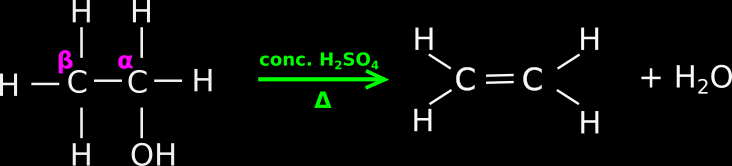
3. To remove the OH group and the H atom, we heat the alcohol with concentrated sulphuric acid. The equation is shown in fig.13.66 below:

Fig.13.66

• Since H and OH are removed, we say that, a molecule of water is removed.
• Since a molecule of water is removed, it is a dehydration reaction.
• Since the dehydration is achieved in the presence of an acid, this reaction is called acidic dehydration reaction.
4. From fig.13.66, it is clear that, the H atom belonging to the β carbon atom is being removed. So this reaction is an example of β-elimination reaction.

In the next section we will see properties of alkenes.


Previous

Contents

Next

Copyright©2022 Higher secondary chemistry.blogspot.com

Monday, October 24, 2022

Chapter 13.8 - Nomenclature of Alkenes

In the previous section, we completed a discussion on conformations of ethane. In this section, we will start a discussion on alkenes.

Let us recall some properties of alkenes that we have seen in earlier chapters. They can be written in 4 steps:
1. Alkenes are unsaturated hydrocarbons. They contain at least one double bond.
2. If there is one double bond in an alkene, it will contain two H atoms less than the corresponding alkane.
• For example:
    ♦ Molecular formula of butane is C4H10
    ♦ Molecular formula of butene is C4H8
• We know that, the general formula for alkanes is CnH2n+2
• We also know that, the corresponding alkene has two H atoms less. So the general formula for alkenes is CnH2n
3. Chemists in the 19th century noticed that, the first member of the alkene series (ethene) formed a oily liquid on reaction with chlorine. So the alkenes were generally known as olefins. The word olefin means ‘oil forming’.
4. Ethene is the IUPAC name of the first member. It’s common name is ethylene.


Structure of double bond

Alkenes have at least one double bond. We have seen the details about that double bond in the previous chapters. [see fig.4.147 of section 4.26 ] Let us recall those details. They can be written in 8 steps:
1. The double bond consists of:
    ♦ One sigma (σ) bond
    ♦ One pi (𝜋) bond.
2. The sigma bond is formed by the head-on overlapping of the sp2 hybridized orbitals.
    ♦ The pi bond is formed by the sideways overlapping of the two 2p orbitals.
3. The sigma bond is a strong bond.
    ♦ Bond enthalpy of a sigma bond is 397 kJ mol-1
• Pi bond is a weak bond.
    ♦ Bond enthalpy of a pi bond is 284 kJ mol-1
4. The double bond is shorter in bond length.
    ♦ The C-C single bond in alkanes has a bond length of 154 pm.
    ♦ The C=C double bond in alkenes has a bond length of 134 pm.
    ♦ The C-H single bond has a bond length of 110 pm.
• The bond angle between C-H single bond and C=C double bond is 121.7o
• The bond angle between the two C-H single bonds in a CH2 group is 116.6o
• These details are shown in fig.13.46 below:

Fig.13.46

5. In a pi bond, there is sideways overlapping of the p-orbitals. The two p-orbitals combine together to form a 𝜋-cloud. We saw this in figs.4.148 and 4.149 of section 4.26.
6. The electrons in the 𝜋-cloud are loosely held.
• Those loosely held electrons are easily available for reagents which are in search for electrons (reagents in search for electrons are known as electrophilic reagents).
• So electrophilic reagents attack alkenes easily.
7. We can say that:
• Alkenes have lesser stability when compared to alkanes.
• Alkenes can be easily converted into alkanes by combining with electrophilic reagents.
8. In step (3), we wrote that:
    ♦ Bond enthalpy of the sigma bond in a double bond is 397 kJ mol-1
    ♦ Bond enthalpy of the pi bond in a double bond is 284 kJ mol-1
• So the bond enthalpy of a C=C double bond as a whole will be (397+284) = 681 kJ mol-1
• The bond enthalpy of a C-C single bond is 348 kJ mol-1

Nomenclature of Alkenes

• We have seen the rules for writing the IUPAC names in an earlier chapter [see section 12.3]
• Let us recall some basic rules which are applicable to alkenes. It can be written in 3 steps:
1. The longest chain should be selected in such a way that, it contains the double bonds.
2. Numbering must be done in such a way that, the double bonds get the lowest possible numbers.
3. The suffix ‘ene’ is used instead of ‘ane’ of alkanes.
• Let us see some examples:

Example 1:
Write the IUPAC name of the structure: CH3-CH=CH2
Solution:
1. Applying rule 1, we see that, there are three C atoms in the main chain.
2. Applying rule 2, we see that, ‘prop’ must be used.
3. Applying rule 3, we get propane.
• But since it is an alkene, we must remove ‘ane’ and replace it with ‘ene’.
• We get: propane – ane + ene = propene
4. Applying rule 4, we see that, there are no branches.
5. Applying rule 5, we see that the correct way of numbering is from right to left.
    ♦ Numbering from right to left will give number ‘1’ to the double bond.
    ♦ Numbering from left to right will give number ‘2’ to the double bond.
6. Rules 6 and 7 are not applicable here because, there are no branches.
• So we can apply rule 8 to assemble the IUPAC name. We get:
Prop-1-ene.
7. Here we note an interesting point:
• In propene, the double bond has only two possible positions. Both those positions will give the same name: Prop-1-ene. So we can write the name simply as: Propene.

Example 2:
Write the IUPAC name of the structure: CH3-CH2-CH=CH2
Solution:
1. Applying rule 1, we see that, there are four C atoms in the main chain.
2. Applying rule 2, we see that, ‘but’ must be used.
3. Applying rule 3, we get butane.
• But since it is an alkene, we must remove ‘ane’ and replace it with ‘ene’.
• We get: butane – ane + ene = butene
4. Applying rule 4, we see that, there are no branches.
5. Applying rule 5, we see that the correct way of numbering is from right to left.
    ♦ Numbering from right to left will give number ‘1’ to the double bond.
    ♦ Numbering from left to right will give number ‘3’ to the double bond.
6. Rules 6 and 7 are not applicable here because, there are no branches.
• So we can apply rule 8 to assemble the IUPAC name. We get:
But-1-ene.

Example 3:
Write the IUPAC name of the structure: CH3-CH=CH-CH3
Solution:
1. Applying rule 1, we see that, there are four C atoms in the main chain.
2. Applying rule 2, we see that, ‘but’ must be used.
3. Applying rule 3, we get butane.
• But since it is an alkene, we must remove ‘ane’ and replace it with ‘ene’.
• We get: butane – ane + ene = butene
4. Applying rule 4, we see that, there are no branches.
5. Applying rule 5, we see that numbering can be done either from left to right or from right to left.
    ♦ Numbering from left to right will give number ‘2’ to the double bond.
    ♦ Numbering from right to left will give number ‘2’ to the double bond.
6. Rules 6 and 7 are not applicable here because, there are no branches.
• So we can apply rule 8 to assemble the IUPAC name. We get:
But-2-ene.

Example 4:
Write the IUPAC name of the structure: CH2=CH-CH=CH2
Solution:
1. Applying rule 1, we see that, there are four C atoms in the main chain.
2. Applying rule 2, we see that, ‘but’ must be used.
3. Applying rule 3, we get butane.
• But since it is an alkene, we must remove ‘ane’ and replace it with ‘ene’.
• We get: butane – ane + ene = butene
4. Applying rule 4, we see that, there are no branches.
5. Applying rule 5, we see that numbering can be done either from left to right or from right to left.
    ♦ Numbering from left to right will give numbers '1,3' to the double bonds.
    ♦ Numbering from right to left will give number ‘1,3’ to the double bonds.
6. Rules 6 and 7 are not applicable here because, there are no branches.
• So we can apply rule 8 to assemble the IUPAC name. We get:
Buta-1,3-diene.
• Note that, since more than one double bond is present, we write 'buta' instead of 'but'
• Similarly, 'penta' is written instead of 'pent', 'hexa' is written instead of hex', so on . . .

Example 5:
Write the IUPAC name of the structure shown in fig.13.47(a) below:

Fig.13.47

Solution:
1. Applying rule 1, we see that, there are three C atoms in the main chain containing double bond.
2. Applying rule 2, we see that, ‘prop’ must be used.
3. Applying rule 3, we get propane.
• But since it is an alkene, we must remove ‘ane’ and replace it with ‘ene’.
• We get: propane – ane + ene = propene
4. Applying rule 4, we see that, there is one branch: methyl.
5. Applying rule 5, we see that numbering should be done from left to right. This is shown in fig.b.
    ♦ Numbering from left to right will give number '1' to the double bond.
    ♦ Numbering from right to left will give number ‘2’ to the double bond.
6. Applying rule 6, we get: 2-methyl.
7. Rule 7 is not applicable here because, there is only one branch.
8. Applying rule 8, we get: 2-Methylprop-1-ene.

Example 6:
Write the IUPAC name of the structure shown in fig.13.48(a) below:

Fig.13.48

Solution:
1. Applying rule 1, we see that, there are four C atoms in the main chain containing the double bond.
2. Applying rule 2, we see that, ‘but’ must be used.
3. Applying rule 3, we get butane.
• But since it is an alkene, we must remove ‘ane’ and replace it with ‘ene’.
• We get: butane – ane + ene = butene
4. Applying rule 4, we see that, there is one branch: methyl.
5. Applying rule 5, we see that numbering should be done from left to right. This is shown in fig.b.
    ♦ Numbering from left to right will give number '1' to the double bond.
    ♦ Numbering from right to left will give number ‘3’ to the double bond.
6. Applying rule 6, we get: 3-methyl.
7. Rule 7 is not applicable here because, there is only one branch.
8. Applying rule 8, we get: 3-Methylbut-1-ene.


Now we will see some solved examples:

Solved example 13.7
Write the IUPAC names of the three compounds shown in fig.13.49 below:

Fig.13.49


Solution:
Part (i):
We are given the condensed formula. It is shown in fig.13.50(a) below:

Fig.13.50

• The expanded form is shown in fig.b. Based on the expanded form, we can write 8 steps: 
1. Applying rule 1, we see that, there are ten C atoms in the main chain containing both the double bonds.
2. Applying rule 2, we see that, ‘dec’ must be used.
3. Applying rule 3, we get decane.
• But since it is an alkene, we must remove ‘ane’ and replace it with ‘ene’.
• We get: decane – ane + ene = decene
4. Applying rule 4, we see that, there are two branches: two methyl branches.
5. Applying rule 5, we see that numbering should be done from left to right. This is shown in fig.b.
    ♦ Numbering from left to right will give numbers '3,6' to the double bonds.
    ♦ Numbering from right to left will give numbers ‘4,7’ to the double bond.
6. Applying rule 6, we get: 2-methyl and 8-methyl.
7. Applying rule 7, we get: 2,8-dimethyl.
8. Applying rule 8, we get: 2,8-Dimethyldeca-3,6-diene.

Part (ii):
We are given the bond line formula. It is shown in fig.13.51(a) below:

Fig.13.51

• The expanded form is shown in fig.b. Based on the expanded form, we can write 6 steps: 
1. Applying rule 1, we see that, there are eight C atoms in the main chain.
2. Applying rule 2, we see that, ‘oct’ must be used.
3. Applying rule 3, we get octane.
• But since it is an alkene, we must remove ‘ane’ and replace it with ‘ene’.
• We get: octane – ane + ene = octene
4. Applying rule 4, we see that, there are no branches.
5. Applying rule 5, we see that numbering can be done either from left to right or from right to left. This is shown in fig.b.
    ♦ Numbering from left to right will give numbers '1,3,5,7' to the double bonds.
    ♦ Numbering from right to left will give the same numbers ‘1,3,5,7’ to the double bonds.
6. Rules 6 and 7 are not applicable here because, there are no branches.
• So we can apply rule 8 to assemble the IUPAC name. We get:
Octa-1,3,5,7-tetraene.

Part (iii):
We are given the condensed formula. It is shown in fig.13.52(a) below:

Fig.13.52

• The expanded form is shown in fig.b. Based on the expanded form, we can write 8 steps: 
1. Applying rule 1, we see that, there are five C atoms in the main chain containing the double bond.
2. Applying rule 2, we see that, ‘pent’ must be used.
3. Applying rule 3, we get pentane.
• But since it is an alkene, we must remove ‘ane’ and replace it with ‘ene’.
• We get: pentane – ane + ene = pentene
4. Applying rule 4, we see that, there is one branch: propyl.
5. Applying rule 5, we see that numbering should be done from left to right. This is shown in fig.b.
    ♦ Numbering from left to right will give number '1' to the double bond.
    ♦ Numbering from right to left will give number ‘4’ to the double bond.
6. Applying rule 6, we get: 2-propyl.
7. Rule 7 is not applicable because, there is only one branch.
8. Applying rule 8, we get: 2-Propylpent-1-ene.

Part (iv):
We are given the expanded form. It is shown in fig.13.53(a) below:

Fig.13.53

• Based on the expanded form, we can write 8 steps: 
1. Applying rule 1, we see that, there are ten C atoms in the main chain containing the double bond.
2. Applying rule 2, we see that, ‘dec’ must be used.
3. Applying rule 3, we get decane.
• But since it is an alkene, we must remove ‘ane’ and replace it with ‘ene’.
• We get: decane – ane + ene = decene
4. Applying rule 4, we see that, there are three branches: two methyl branches and one ethyl branch.
5. Applying rule 5, we see that numbering should be done from right to left. This is shown in fig.b.
    ♦ Numbering from left to right will give number '6' to the double bond.
    ♦ Numbering from right to left will give number ‘4’ to the double bond.
6. Applying rule 6, we get: 2-methyl, 4-ethyl and 6-methyl.
7. Applying rule 7, we get: 4-ethyl-2,6-dimethyl.
(Note that, ethyl gets preference over methyl when we consider the alphabetical order)
8. Applying rule 8, we get: 4-Ethyl-2,6-dimethyldec-4-ene.

Solved example 13.8
Calculate the number of sigma (𝜎) and pi (π) bonds in the four structures in the above solved example 13.7
Solution:
Part (a):
1. From the expanded form in fig.13.50(b), we can count the number of bonds:
   ♦ Counting the number of single bonds, we get: 31 Nos.
        ✰ Number of C-H single bonds = 22 Nos. 
        ✰ Number of C-C single bonds = 9 Nos. 
   ♦ Counting the number of double bonds, we get: 2 Nos. 
        ✰ Number of C=C double bonds = 2 Nos.
2. Number of σ bonds can be calculated in 3 steps:
(i) We know that, all single bonds will be σ bonds.
• So we can write:
    ♦ Number of $\sigma_{C-H}$ = 22
    ♦ Number of $\sigma_{C-C}$ = 9
(ii) We know that, all double bonds will be have one σ bond each.
• The double bond is between two C atoms. In our present case, there are two double bonds.
• So we can write:
    ♦ Number of $\sigma_{C=C}$ = 2
(iii) Now we can write the total numbers:
• Total number of σ bonds:
    ♦ $\sigma_{C-H}$ =22
    ♦ $\sigma_{C-C}$ = 9
    ♦ $\sigma_{C=C}$ = 2
3. Number of π bonds can be calculated in 2 steps:
(i) We know that, all double bonds will be have one π bond each.
• We see that the two double bonds in this structure are between C atoms.
    ♦ So the number of $\pi_{C=C}$ from the two double bonds = 2
(ii) Now we can write the total numbers:
• Total number of π bonds:
    ♦ $\pi_{C=C}$ = 2

Part (b):
1. From the expanded form in fig.13.51(b), we can count the number of bonds:
   ♦ Counting the number of single bonds, we get: 13 Nos.
        ✰ Number of C-H single bonds = 10 Nos. 
        ✰ Number of C-C single bonds = 3 Nos. 
   ♦ Counting the number of double bonds, we get: 4 Nos. 
        ✰ Number of C=C double bonds = 4 Nos.
2. Number of σ bonds can be calculated in 3 steps:
(i) We know that, all single bonds will be σ bonds.
• So we can write:
    ♦ Number of $\sigma_{C-H}$ = 10
    ♦ Number of $\sigma_{C-C}$ = 3
(ii) We know that, all double bonds will be have one σ bond each.
• The double bond is between two C atoms. In our present case, there are four double bonds.
• So we can write:
    ♦ Number of $\sigma_{C=C}$ = 4
(iii) Now we can write the total numbers:
• Total number of σ bonds:
    ♦ $\sigma_{C-H}$ =10
    ♦ $\sigma_{C-C}$ = 3
    ♦ $\sigma_{C=C}$ = 4
3. Number of π bonds can be calculated in 3 steps:
(i) We know that, all double bonds will be have one π bond each.
• We see that the four double bonds in this structure are between C atoms.
    ♦ So the number of $\pi_{C=C}$ from the four double bonds = 4
(ii) Now we can write the total numbers:
• Total number of π bonds:
    ♦ $\pi_{C=C}$ = 4

Part (c):
1. From the expanded form in fig.13.52(b), we can count the number of bonds:
   ♦ Counting the number of single bonds, we get: 22 Nos.
        ✰ Number of C-H single bonds = 16 Nos. 
        ✰ Number of C-C single bonds = 6 Nos. 
   ♦ Counting the number of double bonds, we get: 1 Nos. 
        ✰ Number of C=C double bonds = 1 No.
2. Number of σ bonds can be calculated in 3 steps:
(i) We know that, all single bonds will be σ bonds.
• So we can write:
    ♦ Number of $\sigma_{C-H}$ = 16
    ♦ Number of $\sigma_{C-C}$ = 6
(ii) We know that, all double bonds will be have one σ bond each.
• The double bond is between two C atoms. In our present case, there is one double bond.
• So we can write:
    ♦ Number of $\sigma_{C=C}$ = 1
(iii) Now we can write the total numbers:
• Total number of σ bonds:
    ♦ $\sigma_{C-H}$ =16
    ♦ $\sigma_{C-C}$ = 6
    ♦ $\sigma_{C=C}$ = 1
3. Number of π bonds can be calculated in 3 steps:
(i) We know that, all double bonds will be have one π bond each.
• We see that the one double bond in this structure is between C atoms.
    ♦ So the number of $\pi_{C=C}$ from the one double bonds = 1
(ii) Now we can write the total numbers:
• Total number of π bonds:
    ♦ $\pi_{C=C}$ = 1

Part (d):
1. From the expanded form in fig.13.53, we can count the number of bonds:
   ♦ Counting the number of single bonds, we get: 13 Nos.
        ✰ Number of C-H single bonds = 28 Nos. 
        ✰ Number of C-C single bonds = 12 Nos. 
   ♦ Counting the number of double bonds, we get: 1 No. 
        ✰ Number of C=C double bonds = 1 No.
2. Number of σ bonds can be calculated in 3 steps:
(i) We know that, all single bonds will be σ bonds.
• So we can write:
    ♦ Number of $\sigma_{C-H}$ = 28
    ♦ Number of $\sigma_{C-C}$ = 12
(ii) We know that, all double bonds will be have one σ bond each.
• The double bond is between two C atoms. In our present case, there is one double bond.
• So we can write:
    ♦ Number of $\sigma_{C=C}$ = 1
(iii) Now we can write the total numbers:
• Total number of σ bonds:
    ♦ $\sigma_{C-H}$ =28
    ♦ $\sigma_{C-C}$ = 12
    ♦ $\sigma_{C=C}$ = 1
3. Number of π bonds can be calculated in 3 steps:
(i) We know that, all double bonds will be have one π bond each.
• We see that the one double bond in this structure is between C atoms.
    ♦ So the number of $\pi_{C=C}$ from the one double bonds = 1
(ii) Now we can write the total numbers:
• Total number of π bonds:
    ♦ $\pi_{C=C}$ = 1


In the next section we will see isomerism in alkenes.


Previous

Contents

Next

Copyright©2022 Higher secondary chemistry.blogspot.com

Friday, September 9, 2022

Chapter 13 - Hydrocarbons

In the previous section, we completed a discussion on some basic principles and techniques in organic chemistry. In this chapter, we will see hydrocarbons.

Some basics about hydrocarbons can be written in 7 steps:
1. Consider LPG that we use commonly for cooking purposes. LPG is the abbreviated form of Liquefied Petroleum Gas.
• Let us see some basic details about LPG. It can be written in 4 steps:
(i) Crude oil is a thick black liquid that occurs naturally at many places below the earth’s crust. This oil is refined to obtain useful products like petrol, kerosene etc.,
(ii) Petroleum gas is obtained during this refining process. This gas is liquefied by applying pressure and lowering temperature.
(iii) In the liquid state, this fuel can be easily stored and transported in cylinders and tanks. Thus it becomes available to us for cooking purposes.
(iv) When LPG burns, pollution occurs only to a very small extent.
2. CNG is another fuel. It is used in automobiles. CNG is the abbreviated form of Compressed Natural Gas.
• Let us see some basic details about CNG. It can be written in 3 steps:
(i) Natural gas is a gas which forms naturally above crude oil deposits.
(ii) This gas is collected and compressed to reduce volume. It can then be transported in cylinders, tanks or through pipe lines.
(iii) Like LPG, the CNG also causes pollution only to a very small extent.
3. Other fuels like petrol, diesel and kerosene are already familiar to us.
4. All these fuels are mixtures of various hydrocarbons.
◼ Hydrocarbons are compounds containing only hydrogen and carbon.
5. We know that hydrogen can undergo combustion in the presence of oxygen.
• The balanced equation is:
2H2 (g) + O2 (g) ⟶ 2H2O(g)
6. Similarly, carbon can also undergo combustion in the presence of oxygen.
• The balanced equation is:
C (s) + O2 (g) ⟶ CO2 (g)
7. Hydrocarbons are compounds containing both hydrogen and carbon. So they are good fuels.
• For example, methane can undergo combustion in the presence of oxygen. The balanced equation is:
CH4 (g) + 2O2 (g) ⟶ CO2 (g) + 2H2O (g)
• The main components of LPG are propane and butane.       
• The main component of CNG is methane.
• Petrol, diesel and kerosene contain mixtures of various hydrocarbons.

Classification of hydrocarbons

• Some basics about classification can be written in 6 steps:
1. Since there are a very large number of hydrocarbons, it is essential to classify them into various categories.
• The three main categories are:
(i) Saturated hydrocarbons
(ii) Unsaturated hydrocarbons
(iii) Aromatic hydrocarbons.
2. We know that, carbon is tetravalant. That is., it needs four electrons to attain stability.
• Those four electrons can be obtained through single bonds, double bonds or triple bonds.
3. In saturated hydrocarbons, all bonds will be single bonds.
• Saturated hydrocarbons can be further classified as alkanes and cycloalkanes.
• In alkanes, the first and last C atoms in the chain will not be bonded together. So they do not form closed chains. They are open chain hydrocarbons.   
• In cycloalkanes, the first and last C atoms in the chain will be bonded together. So they form closed chains.   
4. In unsaturated hydrocarbons, one or more bonds will be double or triple bonds.
• If one or more bonds are double bonds, it is classified as an alkene.
• If one or more bonds are triple bonds, it is classified as an alkyne.
• Like cycloalkanes, cycloalkenes and cycloalkynes are also possible.
5. So the classification of hydrocarbons can be represented as in fig.13.1 below:

Hydrocarbons are classified into saturated, unsaturated and aromatic hydrocarbons.
Fig.13.1

6. Aromatic hydrocarbons are a special type of cyclic compounds. The name is derived from the fact that, they have a pleasant odour.
• They are also known as arenes.

Alkanes

• Some basics about alkanes can be written in 13 steps:
1. All bonds in alkanes are single bonds.
2. The first member of the alkane family is methane (CH4).
3. If we remove one H atom from CH4, and put a C atom in it’s place, we get the second member.
• But the valencies of the new C atom should also be satisfied with H atoms. So the second member is C2H6
4. If we remove one H atom from C2H6, and put a C atom in it’s place, we get the third member.
• But the valencies of the new C atom should also be satisfied with H atoms. So the third member is C3H8
5. In this way we can obtain a large number of members. We can write:
• Each member is obtained by two steps:
(i) Remove an H atom from the preceding member.
(ii) Put a -CH3 group in the place of that H atom.
6. We see that:
    ♦ Each member has one C atom more than it’s preceding member.
    ♦ Also each member has two H atoms more than it’s preceding member.
7. The general formula of this homologous series is: CnH2n+2
• n is the number of C atoms.
• If we know the value of n, we can easily calculate the number of H atoms.
8. The first member methane has the simplest structure among all alkanes. It is a tetrahedral structure. We saw the details in an earlier chapter. [see section 4.25]
• Fig.13.2 (a) below shows the ball and stick model of methane.

Ball and stick model of methane shows a tetrahedral structure.
Fig.13.2

Some features of this model can be written in 8 steps:
(i) The central pink sphere represents the C atom.
(ii) The four orange spheres represent the four H atoms.
(iii) The sticks are painted with two different colors.
    ♦ The pink color indicates that, one electron in the bond belongs to C.
    ♦ The orange color indicates that, the other electron in the bond belongs to H.
(iv) The red arrow represents x-axis.
(v) The green arrow represents y-axis.
(vi) The C atom is situated at the origin.
(vii) Consider the stick between the top H atom and the C atom. This stick is perpendicular to the xy-plane.
(viii) If we rotate this CH4 molecule through 90o about the y-axis, the top H atom and it's stick will become aligned with the x-axis.
• This rotation is indicated by the yellow curved arrow.
• The resulting orientation obtained after rotation, is shown in fig.b. It is a rotated tetrahedral structure.
9. Now we can write about the structure of the second member ethane (C2H6). It can be written in 4 steps:
(i) Consider the orientation of tetrahedral CH4 molecule in fig.13.2(b) above.
• Two such tetrahedra are lying along the x-axis and are facing each other in fig.13.3(a) below:

Fig.13.3

(ii) Consider the tetrahedron on the left side. One of it's H atoms lies on the x-axis. This H atom is removed. It then becomes -CH3
(iii) Consider the tetrahedron on the right side. One of it's H atoms lies on the x-axis. This H atom is removed. It then becomes -CH3
(iv) Removal of H atoms will make the molecules unstable. But the two -CH3 can combine together by making a direct bond between the two C atoms. This is shown in fig.18.3(b). It is a C2H6 molecule.
• We can write:
The ethane molecule contains two tetrahedral structures.
10. Now we can write about the structure of the third member propane (C3H8). It can be written in 5 steps:
(i) Consider the orientation of tetrahedral CH4 molecule in fig.13.2(b) above.
• Two such tetrahedra are lying along the x-axis and are facing each other in fig.13.4(a) below. Also a third tetrahedron is approaching from the +ve side of the y-axis.

Fig.13.4

(ii) Consider the tetrahedron on the left side. One of it's H atoms lies on the x-axis. This H atom is removed. It then becomes -CH3
(iii) Consider the tetrahedron on the right side. One of it's H atoms lies on the x-axis. This H atom is removed. It then becomes -CH3
(iv) Consider the third tetrahedron which approaches from the +ve side of the y-axis. Two of it's H atoms are removed. It then becomes -CH2
(iv) Removal of H atoms will make the molecules unstable. But the two -CH3 can combine with the -CH2 by making direct bonds between the three C atoms. This is shown in fig.18.4(b). It is a C3H8 molecule.
• We can write:
The propane molecule contains three tetrahedral structures.
(v) It may be noted that, the three C atoms do not fall along a line.
11. In this way, tetrahedra are joined together to form members of the alkane series.
• The 3D model of butane is shown in fig.13.5 below.
• We can see that:
    ♦ One -CH3 tetrahedron is present at each end of the chain.
    ♦ Two -CH2 tetrahedra are present in the middle.

Fig.13.5

By Ben Mills and Jynto

The original file can be seen here.

12. Scientists have determined the bond lengths in alkanes,
    ♦ The C-C bond length is 154 pm
    ♦ The C-H bond length is 112 pm
13. It is important to remember that, in alkanes, there are no π bonds.
    ♦ All C-C bonds are 𝜎 bonds.
    ♦ All C-H bonds are 𝜎 bonds.
• We saw those details in the previous chapter.


In the next section we will see nomenclature of alkanes.


Previous

Contents

Next

Copyright©2022 Higher secondary chemistry.blogspot.com