Showing posts with label carbocation. Show all posts

Thursday, January 26, 2023

Chapter 13.21 - Applications of Electrophilic Substitution Reactions

In the previous section, we saw that, a SE reaction proceeds in three steps:
(a) Generation of the electrophile ($\rm{E^{\oplus}}$)
(b) Formation of carbocation intermediate
(c) Removal of proton from carbocation intermediate
• We saw the details of the first step. In this section, we will see the remaining two steps.

(b) Formation of carbocation intermediate
This can be written in 6 steps:
1. The electrophile produced in the first step, attacks the benzene ring. This is shown in fig.13.116 below:

Fig.13.116


• Two electrons in a π bond are transferred to the electrophile. This is indicated by the green curved arrow.
2. Those two electrons are used for forming a bond between the electrophile and the benzene ring. Thus the E gets attached to the ring.
• But now a double bond is lost.
3. In the fig.13.116 above, in the product side, consider the C atom to which E and H are attached.
• This C atom is attached to four other atoms:
Two C atoms, One H atom and One E atom.
• So there are four bonds. They are all single bonds. So they are all σ bonds.
• C atom can participate in four σ bonds only if it is sp3 hybridized.
So this C atom is sp3 hybridized.
4. In the fig.13.116 above, in the product side, consider the C atom to which a single H atom is attached. There are only three  bonds around this C atom.
• That means there are only three electrons immediately around this C atom.
• An independent C atom will have four electrons immediately around it. So this C atom will have a +ve formal charge.
5. The product formed in fig.13.116 above is called σ complex. It is also known as arenium ion.
• The arenium ion gets stabilized by resonance. This is shown in fig.13.117 below:

Fig.13.117

• The process taking place in the above fig., is similar to what we saw in fig.12.89(a) in section 12.14.
• The +ve charge moves between three C atoms. There is conjugation between those three C atoms. This gives stability to the cation.
6. We know that, in aromatic compounds, there is delocalisation of electrons among all the C atoms in the ring. But in fig.13.117 above, we see that delocalisation stops at the C atom which is sp3 hybridized. Recall that, delocalisation is possible only if there is a single unhybridized p orbital. Single unhybridized p orbital is available only if the C atom is sp2 hybridized. So it is clear that, arenium ion does not have aromatic character.

(c) Removal of proton from carbocation intermediate
• One C atom in the arenium ion is sp3 hybridized because, it has to accommodate four bond. If the H atom can be removed from that C atom, then it will revert back to sp2 hybridization. So to restore the aromatic character, the arenium ion releases the H atom. This can take place in two different ways:
1. When the reaction is halogenation, alkylation or acylation:
• Consider the case where we are adding a Cl atom to the benzene molecule. In this case, [AlCl4]- will be formed in the reaction mixture. (see fig.13.111 of the previous section).
• Consider the case where we are adding an alkyl group to the benzene molecule. In this case also, [AlCl4]- will be formed in the reaction mixture. (see fig.13.112 of the previous section).
• Consider the case where we are adding an acyl group to the benzene molecule. In this case also, [AlCl4]- will be formed in the reaction mixture. (see fig.13.113 of the previous section).  
• So in all the above three cases, [AlCl4]- will be present in the reaction mixture.
The carbocation intermediate will react with [AlCl4]-. This is shown in fig.13.118 below:

Fig.13.118

• First, the [AlCl4]- undergoes heterolytic cleavage to give AlCl3 and Cl-. This is shown in fig.a
• The two electrons of the C-H bond in the arenium ion, moves to restore the double bond. This is indicated by the curved green arrow in fig.b
• When the electrons move in this way, the H is removed as a proton. We get the substituted benzene ring.
• The proton combines with the Cl- to give one molecule of HCl. This is shown in fig.c
2. When the reaction is nitration:
• Consider the case where we are adding a NO2 group to the benzene molecule. In this case, [HSO4] - will be formed in the reaction mixture. (see fig.13.114 of the previous section).
The carbocation intermediate will react with [HSO4] -. This is shown in fig.13.119 below:

Fig.13.119

• The two electrons of the C-H bond in the arenium ion, moves to restore the double bond. This is indicated by the curved green arrow in fig.a
• When the electrons move in this way, the H is removed as a proton. We get the substituted benzene ring.
• The proton combines with the [HSO4] - to give one molecule of H2SO4. This is shown in fig.b


Now we know how a substitution reaction takes place. Let us see some actual substitution reactions. We have to learn about five reactions. They are: (i) Nitration, (ii) Halogenation (iii) Friedel-Crafts alkylation (iv) Friedel-Crafts acylation (v) Sulphonation

(i) Nitration
• This can be written in 4 steps:
1. The first step is the formation of the electrophile. In our present case, it is $\rm{N^{\oplus} O_2}$. We saw it's formation in fig.13.114 and fig.13.115 in the previous section.
2. In the second step, this electrophile gets attached to the benzene ring to form a carbocation. We saw it in fig.13.117 in this section.
3. In the third step, a H atom is removed from the carbocation. We saw it in fig.13.119 in this section.
4. So we can write the overall reaction as:
• Benzene is heated with a mixture of concentrated nitric acid and concentrated sulphuric acid. As a result, a nitro group is introduced into the benzene ring.
• The equation is shown in fig.13.120 below:

Fig.13.120

• A mixture of concentrated nitric acid and concentrated sulphuric acid is called nitrating mixture.

(ii) Halogenation
• This can be written in 4 steps:
1. The first step is the formation of the electrophile. In our present case, it is $\rm{Cl^{\oplus}}$. We saw it's formation in fig.13.111 in the previous section.
2. In the second step, this electrophile gets attached to the benzene ring to form a carbocation. We saw it in fig.13.117 in this section.
3. In the third step, a H atom is removed from the carbocation. We saw it in fig.13.119 in this section.
4. So we can write the overall reaction as:
• Arenes reacts with halogens in the presence of a Lewis acid like anhydrous FeCl3, FeBr3 or AlCl3 to yield haloarenes.
• The equation is shown in fig.13.121 below:

Fig.13.121

5. If excess halogen molecules are used, more H atoms will be replaced from the benzene ring.
• For example, if we use excess chlorine molecules, all H atoms in the benzene ring will be replaced by Cl atoms. This will result in the formation of hexachlorobenzene (C6Cl6). The equation is shown in fig.13.122 below:

Fig.13.122
     

(iii) Friedel-Crafts alkylation
• This can be written in 5 steps:
1. The first step is the formation of the electrophile. In our present case, it is $\rm{C^{\oplus} H_3}$. We saw it's formation in fig.13.112 in the previous section.
2. In the second step, this electrophile gets attached to the benzene ring to form a carbocation. We saw it in fig.13.117 in this section.
3. In the third step, a H atom is removed from the carbocation. We saw it in fig.13.119 in this section.
4. So we can write the overall reaction as:
• When benzene is treated with an alkyl halide in the presence of a Lewis acid like anhydrous AlCl3, alkyl benzene is formed.
• Two examples are shown in fig.13.123 below:
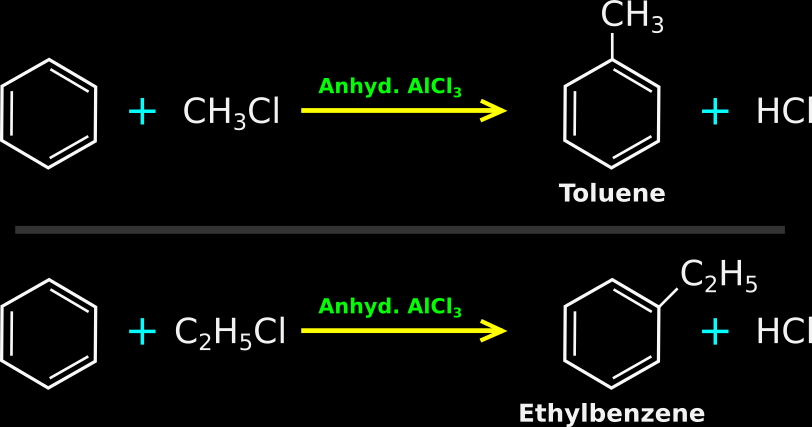
Fig.13.123

5. Let us see an interesting case related to alkylation. It can be written in 4 steps:
(i) In the above examples:
    ♦ When chloromethane was taken, we obtained methylbenzene (toluene).
    ♦ When chloroethane was taken, we obtained ethylbenzene.
(ii) So if we take 1-chloropropane, we would expect n-propyl benzene.
    ♦ n-propyl benzene is shown in fig.13.124(a) below.
(iii) But the actual product is isopropyl benzene.
    ♦ isopropyl benzene is shown in fig.13.124(b) below.

Fig.13.124

(iv) The reason is:
• 1-chloropropane will undergo heterolytic cleavage to give $\rm{CH_3 - CH_2 -C^{\oplus} H_2}$
• In this electrophile, the +ve charge is carried by a primary C atom. There fore it has less stability.
• To achieve stability, it undergoes rearrangement to a form in which the +ve charge is carried by a secondary C atom: $\rm{CH_3 - C^{\oplus}H -C H_3}$
• So in the reaction mixture, the quantity of $\rm{CH_3 - C^{\oplus}H -C H_3}$ will be greater.
• As a result, we will get isopropyl benzene as the major product.

(iv) Friedel-Crafts acylation
• This can be written in steps:
1. The first step is the formation of the electrophile. In our present case, it is $\rm{CH_3 C^{\oplus} O}$. We saw it's formation in fig.13.113 in the previous section.
2. In the second step, this electrophile gets attached to the benzene ring to form a carbocation. We saw it in fig.13.117 in this section.
3. In the third step, a H atom is removed from the carbocation. We saw it in fig.13.119 in this section.
4. So we can write the overall reaction as:
• When benzene is treated with an alcyl halide or acid anhydride in the presence of a Lewis acid like anhydrous AlCl3, alcyl benzene is formed.
• Two examples are shown in fig.13.125 below:

Fig.13.125

(v) Sulphonation
• This can be written in 3 steps:
1. In the case of sulphonation, the first step is not required. This is because, sulphur trioxide (SO3) which is one of the reactants, is already an electrophile.
• The reason for SO3 becoming an electrophile, can be written in 3 steps:
(i) The O atoms being highly electronegative, pulls the electrons from the S atom.
(ii) The S atom thus gains a partial +ve charge.
(iii) This S atom can gain electrons from electron donors.
2. The remaining steps are the same:
• The electrophile gets attached to the benzene ring to form a carbocation. We saw it in fig.13.117 in this section.
• Finally, a H atom is removed from the carbocation. We saw it in fig.13.119 in this section.
3. So we can write the overall reaction as:
• When benzene is heated with fuming sulphuric acid, benzene sulphonic acid is formed.
• The equation is shown in fig.13.126 below:

Fig.13.126


We have completed a discussion on electrophilic substitution reactions of aromatic compounds. In the next section, we will see addition reactions.


Previous

Contents

Next

Copyright©2023 Higher secondary chemistry.blogspot.com

Wednesday, November 9, 2022

Chapter 13.11 - Chemical Properties of Alkenes

In the previous section, we completed a discussion on the preparation of alkenes. In this section, we will see properties of alkenes.

First we will see the physical properties. This can be written in 6 steps:
1. We have already seen the physical properties of alkanes [see section 13.4].
• The physical properties of alkenes and alkanes are similar, except in isomerism and polar nature. This can be explained in 2 steps:
(i) Polar nature:
• Earlier in section 13.4, we saw that alkanes are almost non-polar.
• In section 13.9, we saw that cis-isomers of alkenes show polar nature [see fig.13.58 of section 13.9].
(ii) Isomerism:
• Earlier in section 13.7, we saw that, alkanes can have different conformations.
• But since rotation is restricted in alkenes, they cannot have different conformations. Instead, they show cis/trans isomerism.
2. The first three members of the alkene series are gases.
• The next fourteen members are liquids.
• The members coming after that, are solids.
3. The first member ethene is colorless. But it has a faint sweet smell.
• All other members are colorless and odour less.
4. Alkenes are insoluble in water. But they are soluble in non-polar solvents like benzene and petroleum ether.
(Petroleum ether is obtained from petroleum. It is used as a laboratory solvent)
5. The members of the alkene series show a regular increase in boiling point.
• We know that, for each successive member, the size increases by one CH2 unit.
• For each successive member, the boiling point increases by 20-30 K
6. Difference in boiling points of isomers:
• Consider two isomers of an alkene. Let one of them be of straight chain type and the other branched chain type.
• The straight chain type will have a higher boiling point than the branched chain type.
• We saw the reason in the case of alkanes. The same reason is applicable here also.


Now we will see the chemical properties. Some basics can be written in 2 steps:
1. We know that, each double bond in alkenes consist of a 𝞹-bond. The electrons in the 𝞹-bonds are loosely held. So those electrons are easily available for ‘electron seeking species’ (electrophiles).
2. Due to this availability of electrons, the electrophiles will get attached to the alkenes, resulting in new compounds. We call such reactions as addition reactions. In this section, we will see different types of addition reactions.

A. Addition of dihydrogen
This can be written in 6 steps:
1. Each double bond in an alkene can add one molecule of dihydrogen.
2. The dihydrogen molecule first splits into two H atoms. This is indicated by the blue dashed curves in fig.13.67 below:

Fig.13.67

• Each newly formed H atom will have only one electron (yellow dot). So each H atom will be looking for one more electron to complete octet.
3. The loosely held electrons at the 𝞹-bond will supply the required electrons for the H atoms.
• That means, two of the four red dots in the double bond, will leave the double bond. Those two red dots will help the new H atoms to form single bonds with C atoms.
• Thus we get two new C-H bonds on the sides of the alkane. 
4. So we now know how the H atoms add up to the alkene. The alkene then will no longer require the double bond. It will be converted to an alkane.
5. In an earlier section, we saw this process as a method for preparing alkanes [see section 13.3].
6. For this process, finely divided nickel, palladium or platinum is required as catalyst.

B. Addition of halogens
This can be written in 6 steps:
1. Each double bond in an alkene can add one molecule of halogen.
2. Two individual X atoms (F, Cl, Br or I) must be available for the reaction to take place. This is indicated by two Br atoms in fig.13.68 below:

Fig.13.68

• Each individual X atom will have only seven electrons in the outer most shell.
• This is indicated by the seven dots around the Br atoms.
   ♦ Seven grey dots for the first Br atom
   ♦ Seven yellow dots for the second Br atom.
• So each X atom will be looking for one more electron to complete octet.
3. The loosely held electrons at the 𝞹-bond will supply the required electrons for the X atoms.
• That means, two of the four red dots in the double bond, will leave the double bond. Those two red dots will help the new X atoms to form single bonds with C atoms.
• Thus we get two new C-Br bonds on the sides to form 1,2-Dibromoethane.
4. So we now know how the X atoms add up to the alkene. The alkene then will no longer require the double bond. It will be converted to a dihalide.
5. Note that, two X atoms will be required to convert a double bond to two single bonds. Obviously, the two X atoms will be attached to two adjacent C atoms. Thus the resulting dihalide will be a vicinal dihalide.
6. The equation of the reaction in fig.13.68 above can be written as:
$\rm{CH_2 = CH_2~+~Br-Br~ \color {green}{\xrightarrow[{}]{CCl_4}} ~ CH_2 Br- CH_2 Br}$
7. Another example is shown in fig.13.69 below:

Fig.13.69

• The equation is:
$\rm{CH_3 - CH=CH_2~+~Cl-Cl~ \color {green}{\xrightarrow[{}]{}} ~ CH_3 - CHCl - CH_2 Cl}$
4. Under normal conditions, iodine does not take part in this type of reactions.
5. Let us see how this reaction can be used as a test for the presence of double or triple bonds (test for unsaturation). It can be written in 4 steps:
(i) Bromine solution has a reddish orange color. This color is due to the presence of Br- ions.
(ii) We add this bromine solution to a solution which is to be tested. If the solution contains any double bonds, those double bonds will break. Each double bond will take up two Br- atoms.
(iii) Thus all the Br- ions will be used up. The reddish orange color will disappear.
(iv) So, if the reddish orange color disappear, we will get an indication that, double bonds or triple bonds are present.
6. This type of reaction involves the formation of cyclic halonium ions. We will see those details in higher classes.

C. Addition of hydrogen halides
• In this reaction, the hydrogen halide first splits into two ions.
   ♦ For example, HBr splits into H+ and Br-
• An intermediate product is formed due to the action of the H+ ion.
• So we will see the reaction mechanism in detail. It can be written in 4 steps:
1. First the HBr molecule splits into two parts.
• Since Br is more electronegative, it will retain both electrons in the bond.
• So it is a heterolytic cleavage. It is shown in fig.13.70 (a) below:

Fig.13.70

• Note that, H has lost both the electrons and thus became H+ ion.
• The Br has acquired an extra electron. It is indicated by the gray dot. It has become Br- ion.
2. The H+ attacks the ethene molecule. This is shown in fig.13.70 (b) above.
• At the product side, we see that, the H+ is attached to the left side C atom.
• Note that, the H+ did not bring any electrons. Both electrons required for the bond is made available from the double bond. That is why we see two red dots in the new C-H bond.
3. But now, the double bond is broken (the 𝞹-electrons in the double bond were utilized for the new C-H bond).
• When the double bond is broken, the right side C atom looses an electron.
• This C atom now has sextet only. Thus a carbocation is formed.
• In our present case, it is the ethyl carbocation. We have seen the details about carbocation in a previous section [see fig.12.69 in section 12.10].
4. The Br- now attacks the newly formed carbocation. This is shown in fig.13.70 (c) above.
• The Br- can donate two electrons to form a bond. So it attaches to the right side C atom. Thus we get a molecule of bromoethane.

Let us see another example. It can be written in 4 steps:
1. First the HBr molecule splits into two parts. We get H+ and Br-. It is shown in fig.13.71 (a) below:

Fig.13.71

2. The H+ attacks the alkene molecule. This is shown in fig.13.71 (b) above.
• At the product side, we see that, the H+ is attached to the third C atom.
• Note that, the H+ did not bring any electrons. Both electrons required for the bond is made available from the double bond. That is why we see two red dots in the new C-H bond.
3. But now, the double bond is broken (the 𝞹-electrons in the double bond were utilized for the new C-H bond).
• When the double bond is broken, the second C atom looses an electron.
• This C atom now has sextet only. Thus a carbocation is formed.
4. The Br- now attacks the newly formed carbocation. This is shown in fig.13.71 (c) above.
• The Br- can donate two electrons to form a bond. So it attaches to the second C atom. Thus we get a molecule of 2-Bromobutane.


• Based on the above two examples, we can write:
   ♦ The H atom will attach to one of the two C atoms of the double bond.
   ♦ The X atom will attach to the other C atom of the double bond.
• In both of the two examples that we saw, the original alkene was symmetric. That is., Same groups are attached to either sides of the double bond. So the incoming H atom can attach to any one of the two C atoms of the double bond. Similarly, the incoming X atom can attach to any one of the two C atoms of the double bond. The resulting product will be the same.
• Now let us consider an unsymmetrical alkene. We will take CH3-CH=CH2 (prop-1-ene). We want to know the result when prop-1-ene reacts with HBr
• Let us assume that,
   ♦ the incoming H atom attaches to the second C atom.
   ♦ the incoming Br atom attaches to the first C atom.
         ✰ Then the product will be: CH3-CH2-CH2Br (1-Bromopropane)
• Next, let us assume that,
   ♦ the incoming H atom attaches to the first C atom.
   ♦ the incoming Br atom attaches to the second C atom.
         ✰ Then the product will be: CH3-CHBr-CH3 (2-Bromopropane)
◼ We want to know this:
In an actual reaction, what will be the product? 1-Bromopropane or 2-Bromopropane?
• To find the answer, we must analyze the mechanism of this reaction.
◼ First we will analyze the mechanism of that reaction which produces 1-Bromopropane.  It can be written in 4 steps:

1. First the HBr molecule splits into two parts. We get H+ and Br-. It is shown in fig.13.72 (a) below:

Fig.13.72

2. The H+ attacks the propene molecule. This is shown in fig.13.72 (b) above.
• At the product side, we see that, the H+ is attached to the second C atom.
• Note that, the H+ did not bring any electrons. Both electrons required for the bond is made available from the double bond. That is why we see two red dots in the new C-H bond.
3. But now, the double bond is broken (the 𝞹-electrons in the double bond were utilized for the new C-H bond).
• When the double bond is broken, the first C atom looses an electron.
• This C atom now has sextet only. Thus a carbocation is formed.
4. The Br- now attacks the newly formed carbocation. This is shown in fig.13.72 (c) above.
• The Br- can donate two electrons to form a bond. So it attaches to the first C atom. Thus we get a molecule of 1-Bromopropane.

◼ Next we will analyze the mechanism of that reaction which produces 2-Bromopropane.  It can be written in 4 steps:

1. First the HBr molecule splits into two parts. We get H+ and Br-. It is shown in fig.13.73 (a) below:


Fig.13.73

2. The H+ attacks the propene molecule. This is shown in fig.13.73 (b) above.
• At the product side, we see that, the H+ is attached to the first C atom.
• Note that, the H+ did not bring any electrons. Both electrons required for the bond is made available from the double bond. That is why we see two red dots in the new C-H bond.
3. But now, the double bond is broken (the 𝞹-electrons in the double bond were utilized for the new C-H bond).
• When the double bond is broken, the second C atom looses an electron.
• This C atom now has sextet only. Thus a carbocation is formed.
4. The Br- now attacks the newly formed carbocation. This is shown in fig.13.73 (c) above.
• The Br- can donate two electrons to form a bond. So it attaches to the second C atom. Thus we get a molecule of 2-Bromopropane.


◼ We want to know this:
In an actual reaction, what will be the product? 1-Bromopropane or 2-Bromopropane?
• We can now write the answer. It can be written in 3 steps:
1. We have seen the two possibilities. Let us compare them.
• In fig.13.72, we see that, the carbocation formed, is a primary carbocation. (C+ is attached to only one other C atom)
• In fig.13.73, we see that, the carbocation formed, is a secondary carbocation. (C+ is attached to two other C atoms)
• We saw the details about primary, secondary, tertiary carbocations in an earlier section [see fig.12.69 in section 12.10].
2. We have learnt that, secondary carbocations are more stable than primary carbocations.
• So in the reaction mixture, there will be a greater quantity of secondary carbocations.
• Consequently, the Br- will be reacting more with secondary carbocations. This will result in a greater quantity of 2-bromopropane.
3. So the answer is:
In an actual reaction, the principal product will be 2-Bromopropane.


Let us now try to formulate a general rule to find the product. It can be written in 6 steps:
1. We have seen that, regardless of whether it is a primary carbocation or a secondary carbocation, the Br- will be always attaches to the C+
2. Let us compare the number of H atoms held by the C+:
    ♦ The C+ in a primary carbocation will hold two H atoms.
    ♦ The C+ in a secondary carbocation will hold one H atom.
    ♦ The C+ in a tertiary carbocation will hold zero H atoms.
(The above number of H atoms can be easily obtained by drawing Lewis structures)
3. We know the order of stability of carbocations. The order is:
Tertiary > Secondary > Primary.
• So in a reaction mixture,
    ♦ Quantity of tertiary carbocations will be high.  
    ♦ Quantity of primary carbocations will be low.
4. The Br- will be looking for C+ portion.
• If tertiary carbocations are available, those carbocations will be present in greater quantity. The Br- will then attach to those tertiary carbocations.
• Based on step (2), the observer will get the impression that, Br- selects that C atom with the least number of H atoms.
5. Similarly we can write:
The Br- will be looking for C+ portion.
• If only secondary carbocations and primary carbocations are available, then secondary carbocations will be present in greater quantity. The Br- will then attach to those secondary carbocations.
• Based on step (2), the observer will get the impression that, Br- selects that C atom with the least number of H atoms.
6. The Russian scientist Markovnikov made the above findings while studying such reactions in detail. He framed a rule called Markovnikov’s rule. The rule states that:
The negative part of the addendum gets attached to that carbon atom which possesses lesser number of hydrogen atoms.
(In our present example, the addendum is HBr. Negative part of the addendum is Br-)


In the next section we will see Anti Markovnikov addition.


Previous

Contents

Next

Copyright©2022 Higher secondary chemistry.blogspot.com


Saturday, March 5, 2022

Chapter 12.10 - Organic Reaction Mechanism - Fundamental Concepts

In the previous section, we saw isomerism. In this section, we will see fundamental concepts in organic reaction mechanism.

• In a chemical reaction, the reactant which is being observed is known as substrate.
• In our present discussion, we consider reactions involving organic compounds. So for our present discussion, the organic compound will be the substrate.
• The other substance which reacts with the organic compound will be called the reagent.
• As an organic reaction proceeds, first we get some intermediate products.
   ♦ When the reaction is complete, all the intermediate products will have disappeared.
   ♦ They will be converted into products and byproducts.
   ♦ This is shown in the fig.12.67 below:

Fig.12.67

• We will be interested in collecting the products. But in some cases, the byproducts will also have some commercial value.


• Let us see how an organic reaction can be described. An organic reaction can be described in a sequential order. The order is written in 3 steps below:
(i) First we write the details of electron movement.
• Electron(s) originally possessed by the substrate may get attached to the reagent or vice versa.
(ii) Secondly we write the energies absorbed or released when new bonds are formed and existing bonds are broken.
(iii) Finally, we write the rate at which reactants are transformed to products (quantity of product obtained in unit time).
• The description containing the above three items in sequential order is known as reaction mechanism.
• A good knowledge about the reaction mechanism will help to preplan a reaction so that, maximum quantity of products can be obtained.


We will now see the basic principles which will enable us to write the reaction mechanism.

Fission of a covalent bond

• In an organic reaction, some of the covalent bonds will undergo fission.
   ♦ The word 'fission' means splitting. The dictionary meaning can be seen here.
   ♦ Another word for fission is cleave. The dictionary meaning can be seen here.
• A covalent bond can get cleaved by any one of the two methods:
(i) heterolytic cleavage (ii) homolytic cleavage.
First we will see heterolytic cleavage. It can be written in 9 steps:
1. In heterolytic cleavage, the covalent bond breaks in such away that, both the electrons in that bond stays with one of the fragments.
• This can be explained using an example. It can be written in 5 steps:
(i) Fig.12.68(a) below shows the Lewis dot structure of CH3Br
    ♦ The green dots indicate the one valence electron of H
    ♦ The red dots indicate the four valence electrons of C
    ♦ The blue dots indicate the seven valence electrons of Br.

In heterolytic cleavage both the shared electrons stays with one of the fragments.
Fig.12.68

(ii) The cyan dashed curve indicates that, the bond between C and Br undergoes fission.
• After the fission, we get two species. They are shown in figs.12.68 (b) and (c)
(iii) Fig.b shows that, the C atom now has only six electrons around it.
• This electronic configuration is called sextet electronic configuration.
   ♦ Note that, the C atom has lost one red dot.
   ♦ So C has now a +ve charge.
   ♦ This species is written as: $\mathbf{\rm{{H_3}\overset{+}{C}}}$
(iv) Fig.c shows that, the Br atom now has eight electrons around it.
• We know that, this electronic configuration is called octet electronic configuration.
   ♦ Note that, one red dot which originally belonged to the C, is now with Br.
   ♦ So Br now has a -ve charge.
   ♦ Also there are three lone pairs.
   ♦ This species is written as: $\mathbf{\rm{\overset{-}{Br}}}$
(v) The process in fig.12.68 can be written in a condensed form as shown below:


• The curved arrow indicates that, both the electrons in the bond are transferred to the Br atom.
2. Based on the above example, we can write:
◼ After the heterolysis,
   ♦ One atom has a sextet configuration and a +ve charge.
   ♦ The other atom has an octet configuration and a -ve charge.
         ✰ Also this other atom will have at least one lone pair.
3. A species having a C atom with sextet configuration and a +ve charge is called a carbocation.
   ♦ Earlier, it was called carbonium ion.
• So what we have in fig.12.68(b) above, is a carbocation. In our present case, it can be named as methyl cation or methyl carbonium ion.   
4. Consider fig.12.69(a) below:

Primary  Carbocation is the one which is directly linked to only one C atom.
Fig.12.69

• The compound under went heterolysis in such a way that, there are only six electrons around the right side C atom. Also this C atom is positively charged.
   ♦ So the species as a whole is a carbocation.
• Note the right side C atom which actually lost the electron.
   ♦ It is the positively charged C atom.
   ♦ Only one other C atom is directly attached to this positively charged C atom.
   ♦ So this species is known as primary carbocation.
   ♦ It is named as ethyl cation.
   ♦ It is written as $\mathbf{\rm{CH_3\overset{+}{C}H_2}}$.
5. Consider fig.12.69(b) above.
• It has three C atoms. So it is related to propane. The middle C atom originally had two H atoms.
• But fig.b shows that, the middle C atom has lost an electron.
• Fig.c shows the structural formula. We see that, there are only six electrons around the middle C atom.
   ♦ The middle C atom is the positively charged C atom.
   ♦ Two other C atoms are directly attached to this positively charged C atom.
   ♦ So this species is known as secondary carbocation.
   ♦ It is named as isopropyl cation.
   ♦ It is written as $\mathbf{\rm{(CH_3)_2\overset{+}{C}\,H}}$.
6. Consider the species in fig.12.69(d). It also has three C atoms. The right most C atom is positively charged. But this species cannot be called a secondary carbocation. This is because, the positively charged C atom is directly attached to only one other C atom. It is a primary carbocation.
7. Consider fig.12.70(a) below:

Fig.12.70

• The compound under went heterolysis in such a way that, there are only six electrons around the central C atom.
   ♦ So the species as a whole is a carbocation.
• Note the central C atom which actually lost the electron.
   ♦ It is the positively charged C atom.
   ♦ Three other C atoms are directly attached to this positively charged C atom.
   ♦ So this species is known as tertiary carbocation.
   ♦ It is named as tert-butyl cation.
   ♦ It is written as $\mathbf{\rm{(CH_3)_3\overset{+}{C}}}$.
8. In the above steps, we counted the ‘number of C atoms’ which are directly attached to the positively charged C atom.
• Instead of the ‘number of C atoms’, we can use the ‘number of alkyl groups’ also. This can be explained in 3 steps:
(i) In fig.12.69(a), the positively charged C atom is directly attached to one C atom. This one C atom is from a methyl group. So we can write:
The positively charged C atom is directly attached to one alkyl group.
(ii) In fig.12.69(b) and (c), the positively charged C atom is directly attached to two C atoms. These two C atoms are from methyl groups. So we can write:
The positively charged C atom is directly attached to two alkyl groups.
(iii) In fig.12.70, the positively charged C atom is directly attached to three C atoms. These three C atoms are from methyl groups. So we can write:
The positively charged C atom is directly attached to three alkyl groups.
9. Carbocations are highly unstable.
• To attain stability, they tend to enter into reactions with other species. That means, carbocations are very reactive.
• However, the alkyl groups which are directly attached to the positively charged C atom, help to stabilize the carbocation. We will see the mechanism in later sections.
• Among the four carbocations that we saw above, the tertiary butyl cation has the greatest stability. Followed by isopropyl cation, followed by ethyl cation, followed by methyl cation.


Now we will see the shape of methyl carbocation. It can be written in 3 steps:
1. Recall the shape of methane molecule. Details here.
• The electronic configuration of C is 1s22s22px12py12pz0
• When enough energy is available, one of the two electrons in the 2s orbital jumps to the 2pz orbital. Thus we get four half filled orbitals: 2s12px12py12pz1
• These four orbitals mix together to form the four sp3 hybrid orbitals.
    ♦ Thus the C atom is sp3 hybridized.
• The four H atoms enter into sigma bond with the four sp3 hybrid orbitals to give CH4 molecule. It has a tetrahedral shape.
2. In our present case of methyl carbocation, the C atom has one electron less.
• So the valence electronic configuration just before hybridization will be:
2s12px12py12pz0
• The 2s, 2px and 2py will mix together to give three sp2 hybrid orbitals.
• These three hybrid orbitals will be directed towards the three corners of an equilateral triangle.
    ♦ The nucleus of the C atom will be at the centroid of the triangle.
    ♦ The pz orbital does not participate in the hybridization.
    ♦ It will remain perpendicular to the plane of the triangle.
    ♦ This is shown in fig.12.71 below:

The methyl cation has a triangular planar shape, with the p orbital perpendicular to the plane of the triangle.
Fig.12.71

• The three yellow dashed lines are imaginary lines. They help to visualize the triangular shape in which the hybrid orbitals (shown in pink color) are oriented.
3. What we see in fig.12.71 above, is a 3D view. We have to represent it in 2D form. Consider fig.12.72(a) below. 

Fig.12.72

• A plane is passing through one of the H atoms. The pz orbital lies on this plane. So the orientation of the plane is fixed.
• In this orientation, one of the remaining two H atoms is in front of the plane. So we connect it using a solid wedge. This is shown in fig.b
• The other remaining H atom is behind the plane. So we connect it using a dashed wedge.
• The H atom which lies on the plane is connected using a solid line.
• Thus fig.b gives the 2D representation of the methyl ion.


• In the discussion so far, we saw the heterolysis in which both the electrons in the bond, were removed from the C atom.
• In another type of heterolysis, both the electrons in the bond stays with the C atom. This is shown in fig.12.73 (a) below.

Fig.12.73

• In fig.b, we see that C has an extra blue dot which originally belonged to the Z atom. So the C atom has a -ve charge.
   ♦ This species is written as: $\mathbf{\rm{{H_3}\,\overset{-}{C:}}}$
• The process can be written in a condensed form as shown below:


• The curved arrow indicates that, both the electrons in the bond are transferred to the C atom.
• A carbon species in which the C atom carries a negative charge is called carbanion. In our present case, it is the $\mathbf{\rm{{H_3}\,\overset{-}{C:}}}$. It is named as methyl anion.
• Carbanions are also unstable and hence very reactive.

• The organic reactions which proceed through heterolytic bond cleavage are called ionic reactions.
• They are also known as heteropolar reactions.
• Some times they are just called polar reactions.


In the next section, we will see homolytic cleavage.

Like us on facebook

Discussion on the notes can be started here

Previous

Contents

Next

Copyright©2021 Higher secondary chemistry.blogspot.com