Showing posts with label Formal charge. Show all posts

Sunday, March 27, 2022

Chapter 12.16 - Resonance Effect

In the previous section, we saw the details about stability of resonance structures. In this section, we will see resonance effect.

• We know that inorganic molecules like HCl are polar.
    ♦ The Cl atom being electronegative, pulls the electron density in the covalent bond.
    ♦ This gives Cl a partial -ve charge. Also H gets a partial +ve charge.
    ♦ See section 4.10.
• Some organic molecules are also polar. This can be demonstrated using two examples.

Example 1:
In this example, we analyze the resonance structures of aniline. It can be written in 6 steps:
1. The structure I of fig.12.101 below shows aniline. In this structure, all the atoms have octet.


Positive resonance effect (+R effect) in aniline.
Fig.12.101

• The structure II is obtained by rearranging the electrons present in I
• In I, NㅡC1 is a single bond. But this same NㅡC1 becomes a double bond in II.
• This is because of the movement of electrons indicated by the green curved-arrow.
   ♦ Two electrons from the lone pair of N moves to NㅡC1
   ♦ Those two electrons were singly-owned by N.
   ♦ After the formation of N=C1, the N co-owns those electrons.
   ♦ So N does not lose any electrons.
• So due to the green curved-arrow,
   ♦ N does not lose any electrons.
   ♦ C1 gains two electrons.
• Note the + formal charge of N in II. This can be explained in 3 steps:
(i) An independent N atom will have five electrons around it.
(ii) But in II, there are only four electrons around N.
    ♦ Two from the bonds with the H atoms.
    ♦ Two from the double bond.
(iii) That means, N has lost an electron. Thus it gains one +ve formal charge. 
• Due to the green curved-arrow in I, C1 now possess two new electrons.
• But C1 already has octet. It does not need any electrons.
• So the magenta curved-arrow comes into play.
   ♦ Two electrons in C1=C2 moves to C2
   ♦ They become a lone pair of C2
• Thus the two unwanted electrons gained by C1 through the green curved-arrow, are lost by the action of magenta curved arrow.
• Note the - formal charge of C2 in II. This can be explained in 3 steps:
(i) An independent C atom will have four electrons around it.
(ii) But in II, there are five electrons around C2
    ♦ Two from the lone pair.
    ♦ One from C2ㅡC1
    ♦ One from C2ㅡC3
    ♦ One from C2ㅡH
(iii) That means, C2 has gained an electron. Thus it gains one -ve formal charge. 
2. From the above step (1), we know how structure II is formed. So let us analyze the curved-arrows in structure II
• The C2 in II has two unwanted electrons. So the yellow curved-arrow comes into play.
    ♦ The lone pair of C2 moves to C2ㅡC3.
    ♦ Thus C2ㅡC3  becomes C2=C3.
    ♦ This double bond is shown in III
• When such a double bond is formed, C3 will have two unwanted electrons.
    ♦ So the cyan curved-arrow comes into play.
    ♦ Two electrons in C3=C4 moves to C4
    ♦ They become a lone pair of C4
• Thus the two unwanted electrons gained by C3 through the yellow curved-arrow, are lost by the action of cyan curved arrow.
• Note the - formal charge of C4 in III. This can be explained in 3 steps:
(i) An independent C atom will have four electrons around it.
(ii) But in II, there are five electrons around C4
    ♦ Two from the lone pair.
    ♦ One from C4ㅡC3
    ♦ One from C4ㅡC5
    ♦ One from C4ㅡH
(iii) That means, C4 has gained an electron. Thus it gains one -ve formal charge.
3. From the above step (2), we know how structure III is formed. We can write similar steps to analyze the curved-arrows in structure III.
• Based on those steps, we would see how structure IV is formed.
• The reader is advised to write those steps in his/her own notebook.
4. In effect, we see that:
• Structure I is neutral.
• Structures II, III and IV are not neutral. They are charged.
    ♦ This is due to the movement of electrons as indicated by the curved arrows.
    ♦ Positions with -ve formal charge have high electron densities.
    ♦ Positions with +ve formal charge have low electron densities.
5. So one contributing structure is neutral while the remaining three contributing structures are charged.
• So the hybrid structure will be charged. That means, in a sample of aniline, the molecules will exist in a charged state. This is just like charged molecules in a sample of HCl.
6. In this example, the electrons are transferred away from the substituent group (ㅡNH2 group).
• If the transfer of electrons is away from an atom or substituent group attached to the conjugated system, it is known as positive resonance effect (+R effect)
• A conjugated system is that system in which single bonds and double bonds occur in an alternating arrangement.

Example 2:
In this example, we analyze the resonance structures of nitrobenzene. It can be written in 6 steps:
1. The structure I of fig.12.102 below shows nitrobenzene. In this structure, all the atoms have octet.

Negative resonance effect in nitrobenzene.
Fig.12.102

• The arrow between N and O indicates that, the bond between N and that O is a coordinate bond. Both electrons in that bond originally belonged to N. However, that coordinate bond has no role in our present discussion.
• The structure II is obtained by rearranging the electrons present in I
• Consider the N=O double bond in I. This same N=O becomes a single bond in II.
• This is because of the movement of electrons indicated by the green curved-arrow.
   ♦ Two electrons in the N=O moves to O.
   ♦ They become a lone pair of O
• Due to this movement of electrons, N has lost two electrons. So the magenta curved-arrow comes into play.
   ♦ Two electrons in C1=C2 moves to NㅡC1
   ♦ Thus C1=C2 becomes C1ㅡC2 and NㅡC1 becomes N=C1
• Note the - formal charge of O in II. This can be explained in 3 steps:
(i) An independent O atom will have six electrons around it.
(ii) But in II, there are seven electrons around that O
    ♦ Six from three lone pairs.
    ♦ One from NㅡO
(iii) That means, O has gained an electron. Thus it gains one -ve formal charge.
• Note the + formal charge of C2 in II. This can be explained in 3 steps:
(i) An independent C atom will have four electrons around it.
(ii) But in II, there are only three electrons around C2.
    ♦ One from bond with the H atom.
    ♦ One from C2ㅡC1
    ♦ One from C2ㅡC3
(iii) That means, C2 has lost an electron. Thus it gains one +ve formal charge. 
• Thus the two electrons lost by N through the green curved-arrow, are gained by the action of magenta curved arrow.
2. From the above step (1), we know how structure II is formed. So let us analyze the curved-arrow in structure II
• The C2 in II needs two electrons. So the yellow curved-arrow comes into play.
   ♦ Two electrons in C3=C4 moves to C2ㅡC3
   ♦ Thus C3=C4 becomes C3ㅡC4 and C2ㅡC3 becomes C2=C3.
   ♦ This is shown in III.
• Note the + formal charge of C4 in III. This can be explained in 3 steps:
(i) An independent C atom will have four electrons around it.
(ii) But in III, there are only three electrons around C4.
    ♦ One from bond with the H atom.
    ♦ One from C4ㅡC3
    ♦ One from C4ㅡC5
(iii) That means, C4 has lost an electron. Thus it gains one +ve formal charge. 
3. From the above step (2), we know how structure III is formed. We can write similar steps to analyze the curved-arrow in structure III.
• Based on those steps, we would see how structure IV is formed.
• The reader is advised to write those steps in his/her own notebook.
4. In effect, we see that:
• Structure I is neutral.
• Structures II, III and IV are not neutral. They are charged.
    ♦ This is due to the movement of electrons as indicated by the curved arrows.
    ♦ Positions with -ve formal charge have high electron densities.
    ♦ Positions with +ve formal charge have low electron densities.
5. So one contributing structure is neutral while the remaining three contributing structures are charged.
• So the hybrid structure will be charged. That means, in a sample of nitrobenzene, the molecules will exist in a charged state. This is just like charged molecules in a sample of HCl.
6. In this example, the electrons are transferred towards the substituent group (ㅡNO2 group).
• If the transfer of electrons is towards an atom or substituent group attached to the conjugated system, it is known as negative resonance effect (-R effect).


◼ Note that:
• In example 1 (+R effect), the C atoms in the chain acquired greater electron densities. This is because of the movement of electrons away from the substituent group.
• In example 2 (-R effect), the C atoms in the chain lost electron densities. This is because of the movement of electrons towards the substituent group.


• The atoms or substituent groups which cause +R effect are:
ㅡ halogen, ㅡOH, ㅡOR, ㅡOCOR, ㅡNH2, ㅡNHR, ㅡNR2, ㅡNHCOR
• The atoms or substituent groups which cause -R effect are:
ㅡCOOH, ㅡCHO, >C=O, ㅡCN, ㅡNO2


• As mentioned before, the resonance effect (+R effect and -R effect) occur in conjugated systems. In conjugated systems, single bonds and double bonds in the chain are present in an alternating arrangement.
• Benzene and substituted benzene compounds are examples of a closed chain conjugated system.
• 1,3-butadiene is an example of an open chain conjugated system. It’s condensed formula is shown below:
CH3=CH2ㅡCH2=CH3


◼ Why is it that, the conjugated systems are subjected to +R effect and -R effects ?
• The answer can be written in 3 steps:
1. We know that, in a double bond, there is a 𝜎 bond and a π bond.
• In a 𝜎 bond, there is linear overlap of orbitals. The electrons are locked in position.
• But in a π bond, there is lateral overlap of orbitals. So the electrons are free to move.
2. So the electrons of the π bond move towards an adjacent single bond. That single bond will then become a double bond. We indicated such movements using curved-arrows in the above examples.
• The electrons of the π bond can also move towards an adjacent atom. Those atoms will then become regions of high electron densities. We indicated such movements also using curved-arrows in the above examples.
3. Regions of ‘electron richness’ and ‘electron deficiency’, will make the molecule polar.


In the next section we will see electromeric effect.


Previous

Contents

Next

Copyright©2022 Higher secondary chemistry.blogspot.com

Saturday, March 19, 2022

Chapter 12.15 - Relative Stability of Resonance Structures

In the previous section, we saw the basics about resonance in organic molecules. In this section, we will see how to compare various resonance structures of a molecule.

Rule 1:
    ♦ The resonance structure which has more number of covalent bonds
    ♦ is more stable than
    ♦ The resonance structure which has lesser number of covalent bonds.
• For calculating the number of covalent bonds, a double bond is considered as two bonds. A triple bond is considered as three bonds.
• An example is shown in fig.12.92 below.

Fig.12.92

• This can be explained in 4 steps:
(i) I and II are resonance structures of the same molecule.
• In I, the number of bonds is four. But in II, the number of bonds is three.
• So I will be more stable than II
(ii) Consequently, the hybrid structure will have a greater resemblance to I than II.
• We can say:
Structure I will contribute more towards the hybrid structure.
(iii) Let us check the formal charges. We have seen how to calculate formal charges in section 4.4.
We know that, any independent O atom will have six valence electrons.
• In I, we see that, the bottom O atom has gained an electron.
    ♦ That means, O has gained a -ve charge.
    ♦ Thus the formal charge of that O is ‘-’.
• In II, we see that, both top O and bottom O has gained an electron each.
    ♦ That means, those O atoms have gained a -ve charge each.
    ♦ Thus the formal charge of each of those O atoms is ‘-’.
(iv) We know that, any independent C atom will have four valence electrons.
• In II, we see that, the C atom has lost an electron.
    ♦ That means, C has gained a +ve charge.
    ♦ Thus the formal charge of that C is ‘+’.

Rule 2:
    ♦ The resonance structure in which all atoms have octet
    ♦ is more stable than
    ♦ The resonance structure in which one or more atoms have incomplete octet.
• An example is shown in fig.12.93 below.

Rules for comparing stability of resonance structures.
Fig.12.93

This can be explained in 3 steps:
(i) I and II are resonance structures of the same molecule.
• In I, all atoms have octet.
• In II, the C atom has only six electrons around it.
• So I will be more stable than II
(ii) Consequently, the hybrid structure will have a greater resemblance to I than II.
• We can say:
Structure I will contribute more towards the hybrid structure.
(iii) We know that, any independent C atom will have four valence electrons.
• In II, we see that, the C has lost one of it’s electrons.
    ♦ That means, C has gained a +ve charge.
    ♦ Thus the formal charge of that C is ‘+’.

Rule 3:
    ♦ The resonance structure which has the least 'number of formal charges'
    ♦ is more stable than
    ♦ The resonance structure which has greater 'number of formal charges'.
• An example is shown in fig.12.94 below:

Fig.12.94

This can be explained in 4 steps:
(i) I and II are resonance structures of the same molecule.
• In II, there are two formal charges, while in I, there are none.
• So I will be more stable than II
(ii) Consequently, the hybrid structure will have a greater resemblance to I than II.
• We can say:
Structure I will contribute more towards the hybrid structure.
(iii) We know that, any independent C atom will have four valence electrons.
• In II, we see that, the C atom of methyl branch has lost one of it’s electrons.
    ♦ That means, C has gained a +ve charge.
    ♦ Thus the formal charge of that C is ‘+’.
(iv) We know that, any independent O atom will have six valence electrons.
• In II, we see that, the O atom has gained one electron.
    ♦ That means, O has gained a -ve charge.
    ♦ Thus the formal charge of that O is ‘-’.

Rule 4:
    ♦ The resonance structure which has the -ve charge on more electronegative atom
    ♦ is more stable than
    ♦ The resonance structure which has the -ve charge on less electronegative atom.
• An example is shown in fig.12.95 below:

Fig.12.95

This can be explained in 4 steps:
(i) I and II are resonance structures of the same molecule.
• In II, the -ve charge is at the O atom. This is acceptable.
• In I, the -ve charge is at a C atom. This is also acceptable.
• But the -ve charge tends to be at a more electronegative atom. When O and C are compared, O is more electronegative.
• So II will be more stable than I
(ii) Consequently, the hybrid structure will have a greater resemblance to II than I.
• We can say:
Structure II will contribute more towards the hybrid structure.
(iii) We know that, any independent C atom will have four valence electrons.
• In I, we see that, the C atom of CH2 group has gained an electron.
    ♦ That means, C has gained a -ve charge.
    ♦ Thus the formal charge of that C is ‘+’.
(iv) We know that, any independent O atom will have six valence electrons.
• In II, we see that, the O atom has gained one electron.
    ♦ That means, O has gained a -ve charge.
    ♦ Thus the formal charge of that O is ‘-’.

Rule 5:
This is the reverse of rule 3.
    ♦ The resonance structure which has the +ve charge on more electropositive atom
    ♦ is more stable than
    ♦ The resonance structure which has the +ve charge on less electropositive atom.

Rule 6:
    ♦ The resonance structure in which 'distance between charges' is lesser
    ♦ is more stable than
    ♦ The resonance structure in which 'distance between charges' is greater.
• An example is shown in fig.12.96 below:

Fig.12.96 

• This can be explained in 3 steps:
(i) I and II are resonance structures of the same molecule.
• In I, the charges are close together (on adjacent atoms).
• In II, the distance between the charges is larger.
• So I will be more stable than II
(ii) Consequently, the hybrid structure will have a greater resemblance to I than II.
• We can say:
Structure I will contribute more towards the hybrid structure.
(iii) We know that, any independent C atom will have four valence electrons.
• In I, we see that, the first C atom from left has lost an electron.
    ♦ That means, C has gained a +ve charge.
    ♦ Thus the formal charge of that C is ‘+’.
• In I, we see that, the second C atom from left has gained an electron.
    ♦ That means, C has gained a -ve charge.
    ♦ Thus the formal charge of that C is ‘-’.
• In II, we see that, the first C atom from left has lost an electron.
    ♦ That means, C has gained a +ve charge.
    ♦ Thus the formal charge of that C is ‘+’.
• In II, we see that, the last C atom from left has gained an electron.
    ♦ That means, C has gained a -ve charge.
    ♦ Thus the formal charge of that C is ‘-’.

Rule 7:
Resonance structures which are equivalent, will have the same stability.
• An example is shown in fig.12.97 below:

Equivalent resonance structures make the same contribution towards hybrid structure.
Fig.12.97

• This can be explained in 3 steps:
(i) I and II are resonance structures of the same molecule.
If we rotate I about an axis passing through the CㅡH bond, we will get II.
(ii) We can apply any of the six rules written above. We will see that both are equivalent.
(iii) We know that, any independent O atom will have six valence electrons.
• In I, we see that, the bottom O atom has gained an electron.
    ♦ That means, O has gained a -ve charge.
    ♦ Thus the formal charge of that O is ‘-’.
• In II, we see that, the top O atom has gained an electron.
    ♦ That means, O has gained a -ve charge.
    ♦ Thus the formal charge of that O is ‘-’.

Solved example 12.18
Write the resonance structures of CH2=CHㅡCHO. Indicate the relative stability of the contributing structures.
Solution:
1. The three resonance structures are shown in fig.12.98 below:

Fig.12.98
  
2. First we apply rule 1:
(a) The number of bonds in I is 9
(b) The number of bonds in II is 8
(c) The number of bonds in III is 8
(d) Based on the number of bonds:
    ♦ I is more stable than II
    ♦ I is more stable than III
• So I is the most stable among the three.
3. Based on the number of bonds, II and III has the same stability.
• So we have to apply the other rules to find which one among II and III is more stable.
4. Applying rule 2, we get:
(a) In II, the first C (from left) has an incomplete octet. All other atoms have octet.
(b) In III, the O has an incomplete octet. All other atoms have octet.
(c) So applying rule 2, both II and III have the same stability.
• We have to apply the other rules.
5. Applying rule 3, we get:
(a) The number of formal charges in II is 2  
(b) The number of formal charges in III is also 2
(c) So applying rule 3, both II and III have the same stability.
• We have to apply the other rules.
6. Applying rule 4, we get:
(a) In II, the -ve charge is on the more electronegative atom, which is O
(b) In III, the -ve charge is on the lesser electronegative atom, which is C
(c) So applying rule 4, II is more stable than III
7. So the order of stability in the decreasing order is: I > II > III
• I makes the greatest contribution towards the hybrid structure.
• III makes the least contribution towards the hybrid structure.
• The hybrid structure will have more resemblance to I

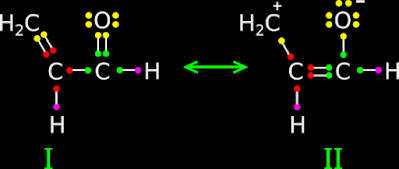
Solved example 12.19
Explain why the following two structures I and II cannot be the major contributors to the real structure of CH3COOCH3

Fig.12.99

Solution:
1. In this problem, we are not asked to compare the two given structures. We are asked why both are not major contributors.
2. Consider I. The middle C atom do not have octet. So this structure cannot be a major contributor.
3. Consider II. A +ve charge is present on the lower O atom. This will make the structure very unstable because, O is highly electronegative. So this structure also cannot be a major contributor.

Solved example 12.20
Indicate the relative stability of the following resonance structures:

Fig.12.100
Solution:
1. First we apply rule 1:
(a) The number of bonds in I is 6
(b) The number of bonds in II is 5
(c) The number of bonds in III is 6
(d) Based on the number of bonds:
    ♦ I and III are more stable than II
• So the least stable structure is II.
2. Based on the number of bonds, I and III has the same stability.
• So we have to apply the other rules to find which one among I and III is more stable.
3. Applying rule 2, we get:
(a) In I, all atoms have octet.
(b) In III also, all atoms have octet.
(c) So applying rule 2, both I and III have the same stability.
• We have to apply the other rules.
4. Applying rule 3, we get:
(a) The number of formal charges in I is 2  
(b) The number of formal charges in III is also 2
(c) So applying rule 3, both II and III have the same stability.
• We have to apply the other rules.
5. Applying rule 4, we get:
(a) In I, the -ve charge is on the more electronegative atom, which is N
(b) In III, the -ve charge is on the lesser electronegative atom, which is C
(c) So applying rule 4, I is more stable than III
6. So the order of stability in the decreasing order is: I > III > II
• I makes the greatest contribution towards the hybrid structure.
• II makes the least contribution towards the hybrid structure.
• The hybrid structure will have more resemblance to I.


In the next section, we will see resonance effect.


Previous

Contents

Next

Copyright©2021 Higher secondary chemistry.blogspot.com


Wednesday, March 16, 2022

Chapter 12.14 - Resonance in Organic Molecules

In the previous section, we saw the details about inductive effect. In this section, we will see resonance.

We have seen some basics about resonance structures in a previous chapter (see section 4.9). Now we will see resonance in organic compounds. Some basics can be written based on some examples.

Example 1:
This can be written in 6 steps:
1. Consider the benzene molecule in fig.12.89(I) below.
• It has single and double bonds in an alternating arrangement.
    ♦ C2ㅡC3, C4ㅡC5, C6ㅡC1, are single bonds.
    ♦ C1ㅡC2, C3ㅡC4, C5ㅡC6, are double bonds.

Resonance structures of benzene have the same energy.
Fig.12.89

2. Consider bond lengths in general:
    ♦ The length of a CㅡC single bond is 154 pm
    ♦ The length of a C=C double bond is 134 pm
• So we would expect both these lengths in a benzene molecule.
• But in reality, all CㅡC bonds in benzene molecule are of the same length, which is: 139 pm
• This 139 pm is an intermediate value of 154 pm and 134 pm.
• So the structure (I) is not acceptable.
3. Consider the molecule in fig.12.89(II). It is the mirror image of the molecule in (I).
    ♦ The single bonds in (I) are double bonds in (II)   
    ♦ The double bonds in (I) are single bonds in (II)
• We can draw the Lewis structure of benzene in this way also. All the atoms have octet.
• But this structure is also not acceptable because, in reality, all bond lengths are the same.
4. Next we consider the energy of molecule (energy stored in the bonds of the molecule)
• Both I and II are energetically same.
    ♦ We cannot say that I is more stable than II.
    ♦ We cannot say that II is more stable than I.
5. So it is clear that, benzene cannot be represented by any one Lewis structure.
• We will have to draw both I and II.
◼ We can write:
    ♦ I and II are resonance structures of benzene.
    ♦ The actual benzene molecule is a hybrid of I and II.
6. Let us see the transfer of electrons taking place during resonance. It can be written in 6 steps:
(i) In structure I of fig.12.89(a) below, all the atoms have octet.
• The structure II is obtained by rearranging the electrons present in I

Electron movement during the resonance in benzene molecule.
Fig.12.89(a)

(ii) In I, C1=C2 is a double bond. But this same C1=C2 becomes a single bond in II.
• This is because of the movement of electrons indicated by the green curved-arrow.
   ♦ Two electrons from the C1=C2 moves to C2ㅡC3
   ♦ Those two electrons were co-owned by C1 and C2
• So due to the green curved-arrow,
   ♦ C1 loses both those electrons.
   ♦ C2 is not affected.
• We will soon see how C1 makes up for this loss.
(iii) Due to the green curved-arrow, C3 now possess two new electrons.
• But C3 already has octet. It does not need any electrons.
• So the magenta curved-arrow comes into play.
   ♦ Two electrons in C3=C4 moves to C4ㅡC5
• Thus the two unwanted electrons gained by C3 through the green curved-arrow, are now lost.
• Recall why the green curved-arrow did not affect C2. In the same way, the magenta curved-arrow will not affect C4
(iv) But the magenta curved-arrow will give two unwanted electrons to C5
• So the cyan curved-arrow comes into play.
   ♦ Two electrons in C5=C6 moves to C6ㅡC1
• Thus the two unwanted electrons gained by C5 through the magenta curved-arrow is now lost.
• Recall why the green curved-arrow did not affect C2.
• Also recall why the magenta curved-arrow did not affect C4.
• In the same way, the cyan curved-arrow will not affect C6
(v) The cyan curved-arrow will give two electrons to C1.
• Thus the electrons initially lost by C1 due to the green arrow, are regained.
(vi) Thus the three curved-arrows show us how the structure II is obtained.
• Even after structure II is obtained, the movement of electrons will continue. This is indicated by the three curved-arrows in II.
• Thus the benzene molecule resonates between I and II. The bonds are neither single nor double. 

Example 2:
This can be written in 7 steps:
1. Consider the nitromethane (CH3NO2) molecule in fig.12.90(I) below.
• It has two nitrogen-oxygen bonds.
    ♦ One nitrogen-oxygen bond is a single bond.
    ♦ The other nitrogen-oxygen bond is a double bond.

Fig.12.90

2. Consider bond lengths in general:
    ♦ The length of a NㅡO single bond is 145 pm.
    ♦ The length of a N=O double bond is 115 pm.
• So we would expect both these lengths in a nitromethane molecule.
• But in reality, both the nitrogen-oxygen bonds in nitromethane are of the same length, which is:125 pm.
• This 125 pm is an intermediate value of 145 pm and 115 pm.
• So the structure (I) is not acceptable.
3. Consider the molecule in fig.12.90(II). It is the mirror image of the molecule in (I).
    ♦ The NㅡO single bond in (I) is a N=O double bond in (II)   
    ♦ The N=O double bond in (I) is a NㅡO single bond in (II)
• We can draw the Lewis structure of nitromethane in this way also. All the atoms have octet.
• But this structure is also not acceptable because, in reality, both the nitrogen-oxygen bond lengths are the same.
4. Next we consider the energy of molecule (energy stored in the bonds of the molecule)
• Both I and II are energetically same.
    ♦ We cannot say that I is more stable than II.
    ♦ We cannot say that II is more stable than I.
5. So it is clear that, nitromethane cannot be represented by any one Lewis structure.
• We will have to draw both I and II.
◼ We can write:
    ♦ I and II are resonance structures of nitromethane.
    ♦ The actual nitromethane molecule is a hybrid of I and II.
6. The +ve sign given to N and -ve sign given to O are formal charges.
• We have seen how to calculate formal charges in section 4.4.
7. Let us see the significance of the curved arrows in fig.12.90 above. It can be written in 5 steps:
(i) The green and magenta curved-arrows show how resonance occurs.
(ii) The green curved-arrow in I shows that, the two electrons in the bond are shifted to the O atom.
• When this shift occurs, the double bond becomes a single bond.
• The two electrons become a lone pair of O. They are no longer available to N. So in effect, the N has now sextet.
(iii) Now the magenta curved-arrow comes into play. Two lone pair electrons of bottom O are shifted to become a double bond. Thus the N atom regains it's octet.
(iv) Thus the two curved-arrows show us how the structure II is obtained.
• Even after structure II is obtained, the movement of electrons will continue. This is indicated by the two curved-arrows in II.
• Thus the molecule resonates between I and II. The bonds are neither single nor double.

Example 3:
This can be written in 7 steps:
1. Consider the acetate ion (CH3CO2-) ion in fig.12.91(I) below.
• It has two carbon-oxygen bonds.
    ♦ One carbon-oxygen bond is a single bond.
    ♦ The other carbon-oxygen bond is a double bond.

Fig.12.91

2. Consider bond lengths in general:
    ♦ The length of a CㅡO single bond is different from the length of a C=O double bond.
• So we would expect two different carbon-oxygen bond lengths in an acetate ion.
• But in reality, both the carbon-oxygen bonds in acetate ion are of the same length.
• This 'same length' is an intermediate value of the two bond lengths.
• So the structure (I) is not acceptable.
3. Consider the molecule in fig.12.91(II). It is the mirror image of the molecule in (I).
    ♦ The CㅡO single bond in (I) is a C=O double bond in (II)   
    ♦ The C=O double bond in (I) is a CㅡO single bond in (II)
• We can draw the Lewis structure of acetate ion in this way also. All the atoms have octet.
• But this structure is also not acceptable because, in reality, both the carbon-oxygen bond lengths are the same.
4. Next we consider the energy of molecule (energy stored in the bonds of the molecule)
• Both I and II are energetically same.
    ♦ We cannot say that I is more stable than II.
    ♦ We cannot say that II is more stable than I.
5. So it is clear that, acetate ion cannot be represented by any one Lewis structure.
• We will have to draw both I and II.
◼ We can write:
    ♦ I and II are resonance structures of acetate.
    ♦ The actual acetate molecule is a hybrid of I and II.
6. The -ve sign given to O is the formal charge.
• We have seen how to calculate formal charges in section 4.4.
7. Let us see the significance of the curved arrows in fig.12.91 above. It can be written in 5 steps:
(i) The green and magenta curved-arrows show how resonance occurs.
(ii) The green curved-arrow in I shows that, the two electrons in the bond are shifted to the O atom.
• When this shift occurs, the double bond becomes a single bond.
• The two electrons become a lone pair of O. They are no longer available to C. So in effect, the C has now sextet.
(iii) Now the magenta curved-arrow comes into play. Two lone pair electrons of bottom O are shifted to become a double bond. Thus the C atom regains it's octet.
(iv) Thus the two curved-arrows show us how the structure II is obtained.
• Even after structure II is obtained, the movement of electrons will continue. This is indicated by the two curved-arrows in II.
• Thus the molecule resonates between I and II. The bonds are neither single nor double.

Based on the above examples, we can write 5 important points related to resonance.
1. We see that, resonance is due to the movement of electrons.
• Always, those electrons in double bonds are being moved. The reason can be written in steps:
(i) The two electrons in a single bond will not be able to move because, single bond is a sigma bond.
    ♦ The sigma bond is a linear overlap of orbitals.
    ♦ Thus the electrons are locked in position.
    ♦ So we do not see any movement of electrons of single bonds.
(ii) In a double bond, there will be a sigma bond and a pi bond.
    ♦ The pi bond occurs due to the lateral overlap of orbitals.
    ♦ The electrons in a pi bond can move.
2. When the electrons are locked in a bond, we say that, those electrons are localized.
• When electrons move away from a bond, they become unpaired electrons of an atom. In such a situation, the electrons appear as clouds. We then say that, those electrons are delocalized.
• When delocalization of electrons take place, the negative charge is spread out on a larger space in the molecule. This gives greater stability to the molecule.
3. All resonance structures must be identical as far as the positions of the atoms are concerned.
• Changes in the positions of atoms are not allowed.
• Only electrons are allowed to move.
4. All resonance structures must be Lewis structures. Each atom in the structure must have octet.
• The only exception allowed is for the carbocation. (carbon with 6 electrons)
5. When there is resonance, a single Lewis structure will not be sufficient to describe a molecule.
• We will need to show all the possible Lewis structures.
• The actual molecule will be a hybrid of the various resonance structures.
• The hybrid will have an average characteristics of the individual resonance structures.


We saw that a molecule can have two or more resonance structures. Our next aim is to compare the stability of those resonance structures. We will see it in the next section.


Previous

Contents

Next

Copyright©2021 Higher secondary chemistry.blogspot.com

Tuesday, April 7, 2020

Chapter 4.4 - Formal Charge

In the previous section, we saw the steps to draw Lewis dot structures of 'polyatomic ions'. In this section, we will see Formal charge

1. Consider the Lewis dot structure of a polyatomic ion
• We saw that, such a structure is placed inside square brackets
• Also, a charge is written at the top right corner
2. This charge is possessed by the ‘ion as a whole’
• This charge does not belong to any particular atom inside the square brackets
3. But we can assign a ‘special type of charge’ on each atom inside the square brackets
• This ‘special type of charge’ is called formal charge
4. Formal charge is applicable to molecules also
■ That is.,
    ♦ We can find the formal charge of each atom in a polyatomic ion
    ♦ We can find the formal charge of each atom in a polyatomic molecule also

Now let us see how formal charge is calculated. It can be calculated in 3 steps:
Step 1: Finding the 'number of valence electrons' owned by a 'bonded atom'
• Consider an atom in a polyatomic molecule or ion
• When it is part of a molecule or ion, it is called a 'bonded atom'
• Any bonded atom will own some valence electrons
• Write down the number of those electrons
(The method to calculate this number is explained further below)
Step 2: Finding the number of valence electrons owned by a 'free atom'
• Consider the same atom when it is not part of any ion or molecule
• We can call such an atom to be:
    ♦ A 'free atom' or
    ♦ An 'isolated atom'
• The free atom owns some valence electrons
• Write down the number of those electrons
(This number is simply the ‘number of valence electrons’ calculated from the electronic configuration of that atom)
Step 3: Finding the formal charge
• Find the following difference:
Number calculated in step (2) – Number calculated in step (1)
• This difference is the formal charge. That is:
Formal charge = Number calculated in step (2) – Number calculated in step (1)

■ But we must take special care while calculating the number in step 1. Let us elaborate:
• We want to find the ‘number of valence electrons owned by a bonded atom’ in the following two cases:
    ♦ When that atom is part of a molecule
    ♦ When that atom is part of an ion
• In both cases, we use the same procedure. The procedure can be written in 3 steps:
(i) Electrons owned through lone pairs:
• If the atom has any lone pairs, all electrons in those pairs will belong to that atom
• So we can write:
The number of electrons owned through lone pairs = (Number of lone pairs × 2)
(ii) Electrons owned through bonds:
• The atom will be having covalent bonds with other atoms
    ♦ Each of those covalent bonds will contain 'two electrons'
• One of those 'two electrons' will belong to the atom under consideration
• So we can write:
The number of electrons owned through covalent bonds = Number of covalent bonds around that atom
■ While counting the ‘number of covalent bonds’:
    ♦ it is important to consider a single bond as one covalent bond
    ♦ it is important to consider a double bond as two covalent bonds 
    ♦ it is important to consider a triple bond as three covalent bonds
(iii) Final number of valence electrons:
• Find the sum of the numbers obtained in (i) and (ii)
• This sum will give the ‘number of valence electrons owned by the bonded atom’

Let us see some examples where we will find the formal charge:
Example 1: O3 (ozone) molecule
• Fig.4.21(a) below, shows the Lewis dot structure of the O3 molecule
• The three O atoms are named as A, B and C
• We have to apply the steps to each of the three O atoms
Fig.4.21
First we will take atom A
Step 1: Finding the 'number of valence electrons' owned by A
(i) Electrons owned through lone pairs:
• The number of electrons owned through lone pairs = (Number of lone pairs × 2) = (1×2) = 2
(ii) Electrons owned through bonds:
• The number of electrons owned through covalent bonds = Number of covalent bonds = 3
(We see a single bond and a double bond around A)
(iii) Final number of valence electrons:
• The sum [(i)+(ii)] = [2+3] = 5
Step 2: Finding the number of valence electrons owned by the 'free atom'
• Atom marked as 'A' is an O atom
• We know that, in the free state, O has 6 valence electrons
Step 3: Finding the formal charge
• Formal charge = Number calculated in step (2) – Number calculated in step (1)
= (6-5) = 1

Next we will take atom B
Step 1: Finding the 'number of valence electrons' owned by B
(i) Electrons owned through lone pairs:
• The number of electrons owned through lone pairs = (Number of lone pairs × 2) = (2×2) = 4
(ii) Electrons owned through bonds:
• The number of electrons owned through covalent bonds = Number of covalent bonds = 2
(We see only one double bond around B)
(iii) Final number of valence electrons:
• The sum [(i)+(ii)] = [4+2] = 6
Step 2: Finding the number of valence electrons owned by the 'free atom'
• Atom marked as 'B' is an O atom
• We know that, in the free state, O has 6 valence electrons
Step 3: Finding the formal charge
• Formal charge = Number calculated in step (2) – Number calculated in step (1)
= (6-6) = 0

Finally, we will take atom C
Step 1: Finding the 'number of valence electrons' owned by C
(i) Electrons owned through lone pairs:
• The number of electrons owned through lone pairs = (Number of lone pairs × 2) = (3×2) = 6
(ii) Electrons owned through bonds:
• The number of electrons owned through covalent bonds = Number of covalent bonds = 1
(We see only one single bond around C)
(iii) Final number of valence electrons:
• The sum [(i)+(ii)] = [6+1] = 7
Step 2: Finding the number of valence electrons owned by the 'free atom'
• Atom marked as 'C' is an O atom
• We know that, in the free state, O has 6 valence electrons
Step 3: Finding the formal charge
• Formal charge = Number calculated in step (2) – Number calculated in step (1)
= (6-7) = -1

■ The formal charges calculated above should be marked in the Lewis dot structure. This is shown in fig.4.21(b) above

Example 2: CH3COO (acetate) ion
• Fig.4.22(a) below, shows the Lewis dot structure of the CH3COO ion
• The seven atoms are named as A, B, C, D, E, F and G 
• We have to apply the steps to each of the seven atoms
Fig.4.22
• We see that, the structure is enclosed within square brackets and a charge of '-1' is given
• This indicates that, it is an ion. Let us check:
■ Finding the number of 'available valence electrons'
• Number of valence electrons of C = 4
• Number of valence electrons of H = 1
• Number of valence electrons of O = 6
• So total number of valence electrons = [(2×4)+(3×1)+(2 × 6)] = 23
■ Finding the number of dots 
• Number of covalent bonds = 7
• Number of lone pairs = 5
• So total number of dots = [(7×2)+(5×2)] = 24
■ So there is one extra dot. This is indicated by the '-' sign at the top right

First we will take atom A
Step 1: Finding the 'number of valence electrons' owned by A
(i) Electrons owned through lone pairs:
• The number of electrons owned through lone pairs = (Number of lone pairs × 2) = (2×2) = 4
(ii) Electrons owned through bonds:
• The number of electrons owned through covalent bonds = Number of covalent bonds = 2
(We see only one double bond around A)
(iii) Final number of valence electrons:
• The sum [(i)+(ii)] = [4+2] = 6
Step 2: Finding the number of valence electrons owned by the 'free atom'
• Atom marked as 'A' is an O atom
• We know that, in the free state, O has 6 valence electrons
Step 3: Finding the formal charge
• Formal charge = Number calculated in step (2) – Number calculated in step (1)
= (6-6) = 0

Next we will take atom B
Step 1: Finding the 'number of valence electrons' owned by B
(i) Electrons owned through lone pairs:
• The number of electrons owned through lone pairs = (Number of lone pairs × 2) = (0×2) = 0
(ii) Electrons owned through bonds:
• The number of electrons owned through covalent bonds = Number of covalent bonds = 4
(We see two single bonds and one double bond around B)
(iii) Final number of valence electrons:
• The sum [(i)+(ii)] = [0+4] = 4
Step 2: Finding the number of valence electrons owned by the 'free atom'
• Atom marked as 'B' is a C atom
• We know that, in the free state, C has 4 valence electrons
Step 3: Finding the formal charge
• Formal charge = Number calculated in step (2) – Number calculated in step (1)
= (4-4) = 0

Next we will take atom C
Step 1: Finding the 'number of valence electrons' owned by C
(i) Electrons owned through lone pairs:
• The number of electrons owned through lone pairs = (Number of lone pairs × 2) = (3×2) = 6
(ii) Electrons owned through bonds:
• The number of electrons owned through covalent bonds = Number of covalent bonds = 1
(We see only one single bond around C)
(iii) Final number of valence electrons:
• The sum [(i)+(ii)] = [6+1] = 7
Step 2: Finding the number of valence electrons owned by the 'free atom'
• Atom marked as 'C' is an O atom
• We know that, in the free state, O has 6 valence electrons
Step 3: Finding the formal charge
• Formal charge = Number calculated in step (2) – Number calculated in step (1)
= (6-7) = -1

Next we will take atom D
Step 1: Finding the 'number of valence electrons' owned by D
(i) Electrons owned through lone pairs:
• The number of electrons owned through lone pairs = (Number of lone pairs × 2) = (0×2) = 0
(ii) Electrons owned through bonds:
• The number of electrons owned through covalent bonds = Number of covalent bonds = 1
(We see only one single bond around D)
(iii) Final number of valence electrons:
• The sum [(i)+(ii)] = [0+1] = 1
Step 2: Finding the number of valence electrons owned by the 'free atom'
• Atom marked as 'D' is a H atom
• We know that, in the free state, H has 1 valence electron
Step 3: Finding the formal charge
• Formal charge = Number calculated in step (2) – Number calculated in step (1)
= (1-1) = 0

Next we will take atom E
Step 1: Finding the 'number of valence electrons' owned by E
(i) Electrons owned through lone pairs:
• The number of electrons owned through lone pairs = (Number of lone pairs × 2) = (0×2) = 0
(ii) Electrons owned through bonds:
• The number of electrons owned through covalent bonds = Number of covalent bonds = 4
(We see four single bonds around E)
(iii) Final number of valence electrons:
• The sum [(i)+(ii)] = [0+4] = 4
Step 2: Finding the number of valence electrons owned by the 'free atom'
• Atom marked as 'E' is a C atom
• We know that, in the free state, C has 4 valence electrons
Step 3: Finding the formal charge
• Formal charge = Number calculated in step (2) – Number calculated in step (1)
= (4-4) = 0

Next we will take atom F
Step 1: Finding the 'number of valence electrons' owned by F
(i) Electrons owned through lone pairs:
• The number of electrons owned through lone pairs = (Number of lone pairs × 2) = (0×2) = 0
(ii) Electrons owned through bonds:
• The number of electrons owned through covalent bonds = Number of covalent bonds = 1
(We see only one single bond around F)
(iii) Final number of valence electrons:
• The sum [(i)+(ii)] = [0+1] = 1
Step 2: Finding the number of valence electrons owned by the 'free atom'
• Atom marked as 'F' is a H atom
• We know that, in the free state, H has 1 valence electron
Step 3: Finding the formal charge
• Formal charge = Number calculated in step (2) – Number calculated in step (1)
= (1-1) = 0

Finally, we will take atom G
Step 1: Finding the 'number of valence electrons' owned by G
(i) Electrons owned through lone pairs:
• The number of electrons owned through lone pairs = (Number of lone pairs × 2) = (0×2) = 0
(ii) Electrons owned through bonds:
• The number of electrons owned through covalent bonds = Number of covalent bonds = 1
(We see only one single bond around G)
(iii) Final number of valence electrons:
• The sum [(i)+(ii)] = [0+1] = 1
Step 2: Finding the number of valence electrons owned by the 'free atom'
• Atom marked as 'G' is a H atom
• We know that, in the free state, H has 1 valence electron
Step 3: Finding the formal charge
• Formal charge = Number calculated in step (2) – Number calculated in step (1)
= (1-1) = 0


■ The formal charges calculated above should be marked in the Lewis dot structure. This is shown in fig.4.22(b) above

Now we will see 5 important points related to formal charges:
1. The formal charges do not indicate the real charge separation within the molecule or ion
This can be explained with examples:
■ In fig.4.21, we cannot say these:
    ♦ The O atom marked as A, 'has a +1 charge'
    ♦ The O atom marked as C, 'has a -1 charge'
■ In fig.4.22, we cannot say this:
    ♦ The O atom marked as C, 'has a -1 charge'
2. Marking the charges in the Lewis dot structure help us to keep track of the electrons
This can be explained with examples
■ In fig.4.21, the O atom marked as A has +1 written near it
• This indicates that, the O atom has lost one electron when compared to the free state
    ♦ In the free state, an O atom will own 6 valence electrons
    ♦ But this particular O atom has only 5 electrons around it
          ✰ 3 electrons from the 3 covalent bonds
          ✰ 2 electrons from the single lone pair
■ In fig.4.21, the O atom marked as C has -1 written near it
• This indicates that, the O atom has gained one electron when compared to the free state
    ♦ In the free state, an O atom will own 6 valence electrons
    ♦ But this particular O atom has 7 electrons around it
          ✰ 1 electron from the single covalent bond
          ✰ 6 electrons from the three lone pairs
■ In fig.4.22, the O atom marked as C has -1 written near it
• This indicates that, the O atom has gained one electron when compared to the free state
    ♦ In the free state, an O atom will own 6 valence electrons
    ♦ But this particular O atom has 7 electrons around it
          ✰ 1 electron from the single covalent bond
          ✰ 6 electrons from the three lone pairs
3. Selecting the suitable structure
• For some molecules and ions, more than one Lewis dot structure is possible
• In such cases, we will want to find ‘the structure with the lowest energy’
• Formal charges will help us in this situation
• ‘The structure with the lowest energy’ is that structure which has the smallest formal charges on the atoms
(We will see the application of this procedure in later sections)
4. Formal charge is based on the following assumptions:
• The bonds between atoms are pure covalent bonds
• In such bonds, the ‘electrons in the pairs’ are shared equally by the neighboring atoms
• If the pair moves towards any one atom, the formal charge will become invalid
5. Sum of formal charges
• Sum of the formal charges in all the atoms in a polyatomic molecule will be zero
• Sum of the formal charges in all the atoms in a polyatomic ion will be equal to the charge of that ion

In the next section, we will see the limitations of the octet rule

PREVIOUS           CONTENTS          NEXT


Copyright©2020 Higher Secondary Chemistry. blogspot.in - All Rights Reserved