Showing posts with label Entropy. Show all posts

Wednesday, March 10, 2021

Chapter 6.15 - Gibbs Free Energy

In the previous section, we saw the second law of thermodynamics. In this section, we will see Gibbs energy

◼ Gibbs energy G is defined as: Eq.6.16: G = H – TS
    ♦ H is the enthalpy of the system
    ♦ T is the temperature of the system
    ♦ S is the entropy of the system
We know that, H, T and S are state functions. So G is also a state function

Now we will see some interesting calculations based on the above equation. It can be written in 11 steps:
1. Initial and final states of the system:
    ♦ At the initial state A, we have: Gsys(A) = Hsys(A) - TSsys(A)
    ♦ At the final state B, we have: Gsys(B) = Hsys(B) - TSsys(B)
2. Now we can find ΔGsys:
ΔGsys = (Gsys(B) - Gsys(A)) = (Hsys(B) - TSsys(B)) - (Hsys(A) - TSsys(A))
⇒ ΔGsys = (Hsys(B) - Hsys(A)) -T(Ssys(B) - Ssys(A))
Thus we get: Eq.6.17: ΔGsys = ΔHsys - T ΔSsys
3. Note that:
    ♦ Eq.6.16 is related to Gibbs energy
    ♦ Eq.6.17 is related to Gibbs energy change
4. Let us do a dimensional analysis of Eq.6.16
• On the right side, we have:
$\mathbf\small{\rm{[Energy]-[Temperature]\times \frac{[Energy]}{[Temperature]}}}$
= [Energy] - [Energy]
= [Energy]
• So we can write: G has the dimensions of energy. In other words, G is a quantity of energy
• ΔG in Eq.6.17 is the difference between two G values. So ΔG is also a quantity of energy
◼ Eq.6.17 is known as the Gibbs equation. It is one of the most important equations in chemistry
5. In earlier sections, we saw that:
    ♦ A decrease in enthalpy (negative ΔH) could be an indication for spontaneity
    ♦ An increase in entropy of the universe is essential for spontaneity
• Now, Eq.6.17 combines both 'change in enthalpy' and 'change in entropy'
6. Let us see how Gibbs energy is related to spontaneity:
• We have the basic equation: Eq.6.14: ΔSuniverse = [ΔSsys + ΔSsurr]
• We calculated the last term Ssurr as follows:
$\mathbf\small{\rm{\Delta S_{surr}=\frac{Heat\,absorbed/released\,by\,surroundings}{T}}}$
7. We saw that:
$\mathbf\small{\rm{Heat\,absorbed/released\,by\,surroundings}}$ is related to the ΔHsys
• The relation can be written in two ways:
(i) If heat ΔHsys is released by the system, that same heat will be absorbed by the surroundings
    ♦ We can write: If ΔHsys is negative, $\mathbf\small{\rm{Heat\,absorbed/released\,by\,surroundings}}$ will be positive but with the same magnitude as ΔHsys
(ii) If heat ΔHsys is absorbed by the system, that same heat will be lost by the surroundings
    ♦ We can write: If ΔHsys is positive, $\mathbf\small{\rm{Heat\,absorbed/released\,by\,surroundings}}$ will be negative but with the same magnitude as ΔHsys
◼ Based on the two points, we can write:
$\mathbf\small{\rm{Heat\,absorbed/released\,by\,surroundings}}$ is the negative of ΔHsys
8. So Eq.6.14 becomes:
ΔSuniverse = [ΔSsys + $\mathbf\small{\rm{\frac{-\Delta H_{sys}}{T}}}$]
• Rearranging this, we get:
TΔSuniverse = TΔSsys - ΔHsys
9. For a spontaneous process, ΔSuniverse will be greater than zero
• T will be always positive because, there are no negative values in the kelvin scale
• Thus we can write:
If the process is spontaneous, (TΔSsys - ΔHsys) will be greater than zero
• (TΔSsys - ΔHsys) can be rearranged as: -(ΔHsys - TΔSsys)
• So we can write:
If the process is spontaneous, -(ΔHsys - TΔSsys) will be greater than zero
• This can be rearranged as:
If the process is spontaneous, (ΔHsys - TΔSsys) will be less than zero
◼ Thus we get an important result:
A process will be spontaneous if: (ΔHsys - TΔSsys) < 0
10. Note that, we are considering the system only. The universe and the surroundings do not come in the equation. So we will drop the subscript 'sys'. We can write:
A process will be spontaneous if: (ΔH - TΔS) < 0
• Also note that, from Eq.6.17, we have: (ΔH - TΔS) = ΔG
◼ So we can write:
A process will be spontaneous if ΔG < 0
11. Consider the equation 6.17: ΔG = ΔH - TΔS
• All three terms are energies
• ΔH is the heat liberated from the system
• But all that ΔH is not available to do work. Because, a quantity of 'TΔS' is being deducted
• The energy remaining after the deduction is the ΔG
• So we can say that, ΔG is the free energy available to do work
◼ For this reason, ΔG is also known as the free energy


Next we will consider the 'possible cases' where a process can be spontaneous or non-spontaneous. It can be written in 6 steps
1. We have Eq.6.17: ΔG = ΔH - TΔS
   ♦ ΔH can be positive or negative
   ♦ ΔS can be positive or negative
   ♦ T can only be positive
        ✰ This is because, there are no negative values in the kelvin scale
2. So four possible cases arise
• Two of them are when ΔH is positive:
   ♦ ΔH positive, ΔS positive
   ♦ ΔH positive, ΔS negative
• Remaining two are when ΔH is negative:
   ♦ ΔH negative, ΔS positive
   ♦ ΔH negative, ΔS negative
3. Let us consider the first case: ΔH +ve, ΔS +ve
• Substituting in Eq.6.17, we get:
ΔG = (+ve) - T(+ve)
• On the right side, first term is positive and second term is negative
   ♦ At small values of T, the first term will be larger
         ✰ Then the result will be a +ve ΔG
   ♦ At large values of T, the first term will be smaller
         ✰ Then the result will be a -ve ΔG
• We know that:
   ♦ -ve ΔG indicates spontaneous process
   ♦ +ve ΔG indicates non-spontaneous process
◼  So for case 1, we can write:
   ♦ ΔH is +ve, ΔS is +ve
         ✰ The process will be spontaneous at large values of T
         ✰ The process will be non-spontaneous at small values of T
◼ This 'case 1' is a special case. It is an endothermic process. That is., heat is absorbed by the system. We see that, if T is increased to a high level, even an endothermic process can be made to take place spontaneously
4. Let us consider the second case: ΔH +ve, ΔS -ve
• Substituting in Eq.6.17, we get:
ΔG = (+ve) - T(-ve)
• On the right side, first term is positive and second term is also positive
   ♦ So whatever be the value of T, ΔG will be always +ve
• We know that:
   ♦ -ve ΔG indicates spontaneous process
   ♦ +ve ΔG indicates non-spontaneous process
◼  So for case 2, we can write:
   ♦ ΔH is +ve, ΔS is +ve
         ✰ Whatever be the value of T, the process will be always non-spontaneous
5. Let us consider the third case: ΔH -ve, ΔS +ve
• Substituting in Eq.6.17, we get:
ΔG = (-ve) - T(+ve)
• On the right side, first term is negative and second term is also negative
   ♦ So whatever be the value of T, ΔG will be always -ve
• We know that:
   ♦ -ve ΔG indicates spontaneous process
   ♦ +ve ΔG indicates non-spontaneous process
◼  So for case 3, we can write:
   ♦ ΔH is -ve, ΔS is +ve
         ✰ Whatever be the value of T, the process will be always spontaneous
6. Let us consider the fourth case: ΔH -ve, ΔS -ve
• Substituting in Eq.6.17, we get:
ΔG = (-ve) - T(-ve)
• On the right side, first term is negative and second term is positive
   ♦ At small values of T, the first term will be larger
         ✰ Then the result will be a -ve ΔG
   ♦ At large values of T, the first term will be smaller
         ✰ Then the result will be a +ve ΔG
• We know that:
   ♦ -ve ΔG indicates spontaneous process
   ♦ +ve ΔG indicates non-spontaneous process
◼  So for case 4, we can write:
   ♦ ΔH is -ve, ΔS is -ve
         ✰ The process will be spontaneous at small values of T
         ✰ The process will be non-spontaneous at large values of T
◼ This 'case 4' is a special case. It is an exothermic process. That is., heat is released by the system. We see that, if T is increased to a high level, even an exothermic process can be made to take place non-spontaneously


Let us see some solved examples:
Solved example 6.30
A reaction, A + B → C + D + q is found to have a positive entropy change. The
reaction will be
(i) possible at high temperature
(ii) possible only at low temperature
(iii) not possible at any temperature
(v) possible at any temperature
Solution:
1. The given equation is: A + B → C + D + q
• It is not a thermochemical equation because, the energy is written along with the equation
• The products constitute of: C, D and q
    ♦ That means, q is also produced. So it is an exothermic reaction
• We can write the thermochemical equation as: A + B → C + D; ΔH = -q
2. So ΔH is negative. We are given that, ΔS is positive
• Thus this process falls under case 3: ΔH -ve, ΔS +ve
3. We can write:
Whatever be the temperature, the given process will be always spontaneous

Solved example 6.31
For the reaction at 298 K,
2A + B → C
∆H = 400 kJ mol-1 and ∆S = 0.2 kJ K-1 mol-1
At what temperature will the reaction become spontaneous considering ∆H and ∆S to be constant over the temperature range
Solution:
1. We have E.6.17: ΔG = ΔH - TΔS
• For the reaction to be spontaneous, ∆G must be less than zero
2. To find the temperature at which the reaction just becomes spontaneous, we put: ∆G = 0
• Thus we get: 0 = ΔH - TΔS
3. Substituting the known values, we get:
0 = 400 (kJ mol-1) - [T (K) × 0.2 (kJ K-1 mol-1)]
⇒ T = 2000 K


Solved example 6.32
For the reaction,
2Cl(g) → Cl2(g), what are the signs of ∆H and ∆S ?
Solution:
1. Sign of ∆H:
• In this process, individual Cl atoms combine to form Cl2 molecules
    ♦ Bond enthalpy will be released
    ♦ So ∆H will be negative
2. Sign of ∆S:
• In the initial state, there are more number of particles
• In the final state, number of particles become half
    ♦ This reduces the disorder/randomness
    ♦ So S decreases
    ♦ Thus ∆S will be negative 

Solved example 6.33
For the reaction
2A(g) + B(g) → 2D(g)
∆U = –10.5 kJ and ∆S = –44.1 J K-1
Calculate ∆G for the reaction, and predict whether the reaction may occur
spontaneously
Solution:
• We have seen this type of problems in section 6.3
• We will solve this problem using Method I only
• The reader may try Method II also
Method I:
1. The given balanced equation is:
2A(g) + B(g) → 2D(g)
• Let A be the initial state
• In this state, the system is:
    ♦ 2 mol of A and 1 mol B at 298 K and P atm pressure
2. Let B be the final state
• In this state, the system is:
    ♦ 2 mol of D at 298 K and P atm pressure
3. We have seen that:
    ♦ Enthalpy in the initial state, HA = (UA + PVA)
    ♦ Enthalpy in the final state, HB = (UB + PVB)
    ♦ So enthalpy change = (HB - HA) = [(UB - UA) + P(VB - VA)]
4. Here, (UB - UA) is given as -10.5 KJ
• So we can write:
[(-10.5) + P(VB - VA)] = HB - HA
5. In the above equation, there are 3 terms: (-10.5), P(VB - VA) and (HB - HA)
• So, if we can find P(VB - VA), we can calculate (HB - HA)
6. P(VB - VA) can be calculated in steps:
(i) From ideal gas equation, we have:
    ♦ PAVA = nARTA
    ♦ PBVB = nBRTB
• In our present case:
    ♦ PA = PB = P
    ♦ TA = TB = T = 298 K
(ii) So P(VB - VA) = (nB - nA)RT
    ♦ nA = number of gaseous moles in the initial state = total number of gaseous moles of A and B = (2+1) = 3
    ♦ nB = number of gaseous moles in the final state = number of gaseous moles of D = 2
    ♦ So (nB - nA) = (2 - 3) = -1
(iii) Substituting the known values, the right side of (ii) becomes:
(-1 mol) × (8.3 J mol-1 K-1) × (298 K) = -2473.4 J = -2.473 kJ
7. We can use the value obtained above, in the place of P(VB - VA) in (4)
• We get: [(-10.5) -2.473] = (HB - HA)
• So (HB - HA) = ΔH = -[12.973] kJ
8. Now we use Eq.6.17: ΔG = ΔH - TΔS
• Substituting the known values, we get:
ΔG = -12.973 × 10³ - (298  × -44.1) = 168.8 J
• Since this value is positive, the reaction is not spontaneous

Solved example 6.34
Calculate the entropy change in surroundings when 1.00 mol of H2O(l) is formed
under standard conditions. ΔH = –286 kJ mol-1
Solution:
1. Given that, ΔH = –286 kJ mol-1
• So 286 kJ will be absorbed by the surroundings
2. We have: $\mathbf\small{\rm{\Delta S_{surr}=\frac{Heat\,absorbed\,by\,surroundings}{T}}}$
• The 286 should be given a +ve sign because, heat content of the surroundings increases due to the absorption
• We get: $\mathbf\small{\rm{\Delta S_{surr}=\frac{286 \times 10^3}{298}}}$ = 959.73 J K-1


• In the next chapter, we will see equilibrium


Previous

Contents

Next

Copyright©2021 Higher secondary chemistry.blogspot.com


Monday, March 8, 2021

Chapter 6.14 - Second Law of Thermodynamics

In the previous section, we saw some basics about entropy. In this section, we will see the second law of thermodynamics

◼ The second law of thermodynamics states that:
When a spontaneous process takes place, the entropy of the universe always increases
• This can be explained in 6 steps:
1. Universe is equivalent to (system + surroundings)
• So entropy of universe, Suniverse = Ssys + Ssurr
2. Initial and final states:
    ♦ At the initial state A, we have: Suniverse(A) = Ssys(A) + Ssurr(A)
    ♦ At the final state B, we have: Suniverse(B) = Ssys(B) + Ssurr(B)
3. The second law states that, the entropy of the universe always increases
    ♦ That means: Suniverse(B) must be larger than Suniverse(A)
    ♦ That means: [Suniverse(B) - Suniverse(A)] must be greater than zero
    ♦ That means: ΔSuniverse must be greater than zero
4. We have:
ΔSuniverse = [Suniverse(B) - Suniverse(A)]
⇒ ΔSuniverse = [(Ssys(B) + Ssurr(B)) - (Ssys(A) + Ssurr(A))]
⇒ ΔSuniverse = [(Ssys(B) - Ssys(A)) + (Ssurr(B) - Ssurr(A))]
• Thus we get Eq.6.14: ΔSuniverse = [ΔSsys + ΔSsurr]
5. So based on the second law, we can write:
For a process to be spontaneous, ΔSuniverse > 0
6. From (4), it is clear that:
To calculate ΔSuniverse, we must know ΔSsys and ΔSsys
    ♦ We know how to find ΔSsys
        ✰ see solved examples 6.23 and 6.24 of the previous section
    ♦ Later in this section, we will see the method to find ΔSsurr


• Using the second law, we can predict the direction of a process
• For that, we look at the entropy in two directions
1. First we consider the direction from left to right
• When the process proceeds in this direction, if we get ΔSuniverse > 0, then the  process will occur spontaneously in this direction
• That means, no external energy is required for the reaction to proceed from left to right
• The opposite is also true:
When the process proceeds in this direction, if we get ΔSuniverse < 0, then the  process will not occur spontaneously in this direction
• That means, external energy is required for the reaction to proceed from left to right
2. Next we consider the direction from right to left
• When the process proceeds in this direction, if we get ΔSuniverse > 0, then the  process will occur spontaneously in this direction
• That means, no external energy is required for the reaction to proceed from right to left 
• The opposite is also true:
When the process proceeds in this direction, if we get ΔSuniverse < 0, then the process will not occur spontaneously in this direction
• That means, external energy is required for the reaction to proceed from right to left


• As mentioned in (6) above, our next aim is to find ΔSsurr. It can be written in 5 steps:
1. Initial and final entropies:
• We have:
    ♦ Entropy of the surroundings in the initial state = Ssurr(A)
    ♦ Entropy of the surroundings in the final state = Ssurr(B)
2. Then change in entropy ΔSsurr = Ssurr(B) – Ssurr(A)
3. This change in entropy is due to the absorption of a heat Q
• This Q can be large or small:
• If Q is large, Ssurr(B) will be large
    ♦ (Because, large Q causes large disorder)
    ♦ Then ΔSsurr will be large
• If Q is small, Ssurr(B) will be small
    ♦ Then ΔSsurr will be small
◼ We can write:
ΔSsurr is directly proportional to Q
4. Based on experiments, scientists obtained another information. It can be written in 6 steps:
(i) Let the surroundings be at a lower temperature T1
    ♦ Let a heat Q be added to the surroundings
    ♦ Let the resulting change in entropy be ΔSsurr(1)
(ii) Let the surroundings be at a higher temperature T2
    ♦ Let the same heat Q be added to the surroundings
    ♦ Let the resulting change in entropy be ΔSsurr(2)
(iii) Here we see an interesting fact:
    ♦ ΔSsurr(2) will be smaller than ΔSsurr(1)
• Let us analyze the reason:
(iv) At the lower temperature T1, the surroundings is somewhat calm
    ♦ To the calm surroundings, we are adding Q
• At the higher temperature T2, the surroundings will already have some disorder
    ♦ To that disordered surroundings, we are adding the same Q
(v) Observing the 'change in disorder' at two temperatures:
    ♦ The 'change in disorder' created by Q at the lower temperature T1
    ♦ Will be more observable than
    ♦ The 'change in disorder' created by the same Q at the higher temperature T2
• This is because, at T2, the surroundings already have some disorder
(vi) So we can write:
    ♦ ΔSsurr(1) at lower temperature is high
    ♦ ΔSsurr(2) at higher temperature is low
• That means:
ΔSsurr is inversely proportional to the temperature
5. So we have two information:
    ♦ From (3), we have: ΔSsurr is directly proportional to Q
    ♦ From (4), we have: ΔSsurr is inversely proportional to T
◼ Combining the two, we get:
Eq.6.15: $\mathbf\small{\rm{\Delta S_{surr}=\frac{Q}{T}}}$
• From this equation, it is clear that, units of entropy is J K-1


Now that we know the two terms of Eq.6.14, we will see a practical application of the second law. The following five solved example demonstrates the application

Solved example 6.25
Prove that:
   ♦ Ice will not melt spontaneously at -5 C
   ♦ Ice will begin to melt spontaneously at 0 C
   ♦ Ice will melt spontaneously at 5 C
Given that: For the process H2O(s)  H2O(l), ΔS = 22.0 J K-1 mol-1
Solution:
1. We have to analyze the process: H2O(s)  H2O(l)
• We have seen this process in an earlier section. (see 'Enthalpy changes during phase transformations' in section 6.6)
• The thermochemical equation is: H2O(s)  H2O(l) ΔHfusion = 6.00 kJ mol-1
2. To determine whether a process is spontaneous, we have to apply Eq.6.14:
ΔSuniverse = [ΔSsys + ΔSsurr]
3. First we will find ΔSsys
• But it is already given in the question. ΔSsys = ΔS = 22.0 J K-1 mol-1
• Let us consider one mol ice. Then we can ignore the 'mol-1'
• We can write:
For our present system, ΔSsys = 22.0 J K-1
4. Next we will find ΔSsurr
• We have Eq.6.15: $\mathbf\small{\rm{\Delta S_{surr}=\frac{Q}{T}}}$
5. From the thermochemical equation, we see that, when 1 mol ice melts, the surroundings will lose 6.00 kJ energy
   ♦ Let QA be the initial heat of the surroundings
   ♦ Let QB be the final heat of the surrounding
• QB will be less than QA because, heat is lost by the surroundings
   ♦ This lost heat is used up for melting the ice
• The change of heat = (QB -QA) = -6 kJ
   ♦ The -ve sign is to be given for 6 because, QB will be less than QA
6. Substituting the known values in (4), we get:
$\mathbf\small{\rm{\Delta S_{surr}=\frac{-6000(J)}{T(K)}}}$
7. Now the result in (2) becomes:
ΔSuniverse = [22.0 J K-1 + $\mathbf\small{\rm{\frac{-6000(J)}{T(K)}}}$]
• Now we can take up each case
8. Case 1: When temperature is -5 C
• -5 C is 268 K
• So the result in (7) becomes:
ΔSuniverse = [22.0 J K-1 + $\mathbf\small{\rm{\frac{-6000(J)}{268(K)}}}$] = -0.3881
◼  This is a negative value. So we can write:
If this process takes place at -5 C, entropy of the universe decreases
• Any process which causes a decrease in entropy of the universe will not be spontaneous
   ♦ So the process H2O(s)  H2O(l) is not spontaneous at -5 C
   ♦ The reverse process H2O(l)  H2O(s) will be spontaneous at -5 C
9. Case 2: When temperature is 0 C
• 0 C is 273 K
• So the result in (7) becomes:
ΔSuniverse = [22.0 J K-1 + $\mathbf\small{\rm{\frac{-6000(J)}{273(K)}}}$] = 0.022
◼  This value is close to zero. So we can write:
If this process takes place at 0 C, entropy of the universe neither increases nor decreases
• Any process which neither increases nor decreases the entropy of the universe will be at equilibrium
   ♦ So the process H2O(s)  H2O(l) is at equilibrium at 0 C
   ♦ If the temperature rises just above 0 C, melting will begin
10. Case 3: When temperature is +5 C
• +5 C is 278 K
• So the result in (7) becomes:
ΔSuniverse = [22.0 J K-1 + $\mathbf\small{\rm{\frac{-6000(J)}{278(K)}}}$] = 0.4172 J K-1
◼  This is a positive value. So we can write:
If this process takes place at +5 C, entropy of the universe increases
• Any process which causes an increase in entropy of the universe will be spontaneous
   ♦ So the process H2O(s)  H2O(l) is spontaneous at +5 C
   ♦ The reverse process H2O(l)  H2O(s) will not be spontaneous at +5 C

Solved example 6.26
The process White Tin(s) → Gray Tin(s) occurs when the surrounding temperature falls just below 13.2 C. The ΔH for the process is -2.1 kJ mol-1. What is the ΔS for the process? Which one has greater order? White tin or Gray tin?
Solution:
1. We have to analyze the process: White Tin(s)  Gray Tin(s); ΔH = -2.1 kJ mol-1
2. To determine whether a process is spontaneous, we have to apply Eq.6.14:
ΔSuniverse = [ΔSsys + ΔSsurr]
3. First we will write ΔSsys
• We have: ΔSsys = S[Product] - S[Reactants]
⇒ ΔSsys = S[Gray] - S[White]
4. Next we will find ΔSsurr
We have Eq.6.15: $\mathbf\small{\rm{\Delta S_{surr}=\frac{Q}{T}}}$
5. From the thermochemical equation, we see that, when one mol white Tin gets converted into one mol gray Tin, 2.1 kJ is released
• So the surroundings will gain 2.1 kJ energy
   ♦ Let QA be the initial heat of the surroundings
   ♦ Let QB be the final heat of the surrounding
• QB will be greater than QA because, heat is gained by the surroundings
• The change of heat = (QB - QA) = +2.1 kJ
   ♦ The +ve sign is to be given for 2.1 because, QB will be greater than QA
6. Substituting the known values in (4), we get:
$\mathbf\small{\rm{\Delta S_{surr}=\frac{+2100(J)}{T(K)}}}$
7. Now the result in (2) becomes:
ΔSuniverse = [S[Gray] - S[White] + $\mathbf\small{\rm{\frac{+2100(J)}{T(K)}}}$]
8. Given that, the conversion just begins at 13.2 C
    ♦ That means, at 13.2 C, the system is in equilibrium
    ♦ That means, at 13.2 C, there is no change in entropy of the universe
    ♦ That means, at 13.2 C, ΔSuniverse = 0
• 13.2 C is equal to (273.15 + 13.2) = 286.4 K
9. So the result in (7) becomes:
0 = [S[Gray] - S[White] + $\mathbf\small{\rm{\frac{+2100(J)}{286.4(K)}}}$]
⇒ S[Gray] - S[White] = $\mathbf\small{\rm{\frac{-2100(J)}{286.4(K)}}}$ = -7.33 J K-1
10. So we can write:
ΔS for the process White Tin(s) → Gray Tin(s) is -7.33 J K-1
11. The -ve value of the ΔS indicates that, the entropy decreases
    ♦ That means, the reactant has greater entropy
    ♦ That means, the reactant has greater disorder
    ♦ That means the product has greater order
• So we can write:
Gray Tin has greater order

Solved example 6.27
The process Orthorhombic Sulfur(s) → Monoclinic Sulfur(s) occurs when the surrounding temperature rises just above 95.3 C. The ΔH for the process is +0.401 kJ mol-1. What is the ΔS for the process? Which one has greater order? Orthorhombic Sulfur or Monoclinic Sulfur?
Solution:
1. We have to analyze the process:
Orthorhombic Sulfur(s) Monoclinic Sulfur(s); ΔH = +0.401 kJ mol-1
2. To determine whether a process is spontaneous, we have to apply Eq.6.14:
ΔSuniverse = [ΔSsys + ΔSsurr]
3. First we will write ΔSsys
• We have: ΔSsys = S[Product] - S[Reactants]
⇒ ΔSsys = S[Mono] - S[Ortho]
4. Next we will find ΔSsurr
• We have Eq.6.15: $\mathbf\small{\rm{\Delta S_{surr}=\frac{Q}{T}}}$
5. From the thermochemical equation, we see that, when one mol ortho gets converted into one mol mono, 0.401 kJ is absorbed
• So the surroundings will lose 0.401 kJ energy
   ♦ Let QA be the initial heat of the surroundings
   ♦ Let QB be the final heat of the surrounding
• QB will be lesser than QA because, heat is lost by the surroundings
• The change of heat = (QB - QA) = -0.401 kJ
   ♦ The -ve sign is to be given for 0.401 because, QB will be lesser than QA
6. Substituting the known values in (4), we get:
$\mathbf\small{\rm{\Delta S_{surr}=\frac{-401(J)}{T(K)}}}$
7. Now the result in (2) becomes:
ΔSuniverse = [S[Mono] - S[Ortho] + $\mathbf\small{\rm{\frac{-401(J)}{T(K)}}}$]
8. Given that, the conversion just begins at 95.3 C
    ♦ That means, at 95.3 C, the system is in equilibrium
    ♦ That means, at 95.3 C, there is no change in entropy of the universe
    ♦ That means, at 95.3 C, ΔSuniverse = 0
• 95.3 C is equal to (273.15 + 95.3) = 368.45 K
9. So the result in (7) becomes:
0 = [S[Mono] - S[Ortho] + $\mathbf\small{\rm{\frac{-401(J)}{368.45(K)}}}$]
⇒ S[Mono] - S[Ortho] = $\mathbf\small{\rm{\frac{401(J)}{368.45(K)}}}$ = 1.09 J K-1
10. So we can write:
ΔS for the process Orthorhombic Sulfur(s) → Monoclinic Sulfur(s) is 1.09 J K-1
11. The +ve value of the ΔS indicates that, the entropy increases
    ♦ That means, the product has greater entropy
    ♦ That means, the product has greater disorder
    ♦ That means the reactant has greater order
• So we can write:
Orthorhombic sulfur has greater order

Solved example 6.28
Calculate the entropy change for oxidation of iron, 4Fe(s) + 3O2 (g) → 2Fe2O3(s). Inspite of negative entropy change of this reaction, why is the reaction spontaneous at 298 K?
(ΔHr of the reaction is –1648 × 103 J mol-1)
Solution:
1. We have already calculated the entropy change for this reaction
(see solved example 6.23 of the previous section)
• We got: ΔSr = -549.74 J K-1
2. To determine whether a process is spontaneous, we have to apply Eq.6.14:
ΔSuniverse = [ΔSsys + ΔSsurr]
3. The result in (1) is ΔSsys
So we have: ΔSsys = -549.74 J K-1
4. Next we will find ΔSsurr
• We have Eq.6.15: $\mathbf\small{\rm{\Delta S_{surr}=\frac{Q}{T}}}$
5. From the data given, we see that, during the reaction, 1648 × 103 J is released
• So the surroundings will gain 1648 × 103 J energy
   ♦ Let QA be the initial heat of the surroundings
   ♦ Let QB be the final heat of the surrounding
• QB will be greater than QA because, heat is gained by the surroundings
• The change of heat = (QB - QA) = +1648 × 103 J
   ♦ The +ve sign is to be given for 1648 × 103 because, QB will be greater than QA
6. Substituting the known values in (4), we get:
$\mathbf\small{\rm{\Delta S_{surr}=\frac{+1648 × 10^3 (J)}{T(K)}}}$
7. Now the result in (2) becomes:
ΔSuniverse = [-549.74 J K-1 + $\mathbf\small{\rm{\frac{+1648 × 10^3(J)}{T(K)}}}$]
8. We have to examine the reaction at 298 K. So T = 298 K
9. So the result in (7) becomes:
ΔSuniverse = [-549.74 J K-1 + $\mathbf\small{\rm{\frac{+1648 × 10^3(J)}{298(K)}}}$]
⇒ ΔSuniverse = 4980.5
10. This is a positive value
• That means, the entropy of the universe increases
• So the process will be spontaneous

Solved example 6.29
Calculate the temperature at which the following reaction becomes spontaneous:
CaCO3(s) → CaO(s) + CO2(g); ΔHr = +179 kJ mol-1
Solution:
1. We have to analyze the process:
CaCO3(s) → CaO(s) + CO2(g); ΔHr = +179 kJ mol-1
2. To determine whether a process is spontaneous, we have to apply Eq.6.14:
ΔSuniverse = [ΔSsys + ΔSsurr]
3. We have: ΔSsys = S[Product] - S[Reactants]
⇒ ΔSr = S[CaO(s)] + S[CO2(g)] - S[CaCO3(s)]
⇒ ΔSr = 39.75 + 213.74 - 92.9 = 160.59
4. Next we will find ΔSsurr
• We have Eq.6.15: $\mathbf\small{\rm{\Delta S_{surr}=\frac{Q}{T}}}$
5. From the data given, we see that, during the reaction, 179 × 103 J is absorbed
• So the surroundings will lose 179 × 103 J energy
   ♦ Let QA be the initial heat of the surroundings
   ♦ Let QB be the final heat of the surrounding
• QB will be lesser than QA because, heat is lost by the surroundings
• The change of heat = (QB - QA) = -179 × 103 J
   ♦ The -ve sign is to be given for 179 × 103 because, QB will be lesser than QA
6. Substituting the known values in (4), we get:
$\mathbf\small{\rm{\Delta S_{surr}=\frac{-179 × 10^3 (J)}{T(K)}}}$
7. Now the result in (2) becomes:
ΔSuniverse = [160.59 J K-1 + $\mathbf\small{\rm{\frac{-179 × 10^3(J)}{T(K)}}}$]
8. We want ΔSuniverse to be positive. Only then will the reaction become spontaneous
• The sign of ΔSuniverse is decided by two terms:
   ♦ 160.59 and $\mathbf\small{\rm{\frac{-179 × 10^3(J)}{T(K)}}}$
• 179 × 103 is very large when compared to 160.59
   ♦ So we will want a large 'T' to make the second term small
9. We will first find the equilibrium temperature by equating ΔSuniverse to zero. We get:
0 = [160.59 J K-1 + $\mathbf\small{\rm{\frac{-179 × 10^3(J)}{T(K)}}}$]
⇒ T = 1114.64 K
10. If we raise T a little above 1114.64 K, the reaction will become spontaneous


• In the next section, we will see Gibbs energy


Previous

Contents

Next

Copyright©2021 Higher secondary chemistry.blogspot.com


Saturday, March 6, 2021

Chapter 6.13 - Entropy

In the previous section, we saw some basics about spontaneity. In this section, we will see entropy and the second law of thermodynamics

• We saw that, being exothermic/endothermic is not the only criterion for spontaneity
• So to investigate further, we consider a system which cannot be exothermic or endothermic
    ♦ For that, we consider a system in which there is no heat transfer
    ♦ Such a system is called an isolated system
• It can be written in 18 steps

1. Consider the closed container in fig.6.21(a) below. It is an isolated container
• It is ‘isolated’ because, there is no flow of energy into or out of the container

Increased entropy means increased disorder.
Fig.6.21

2. On the left side of the container, there are some cold molecules of an ideal gas
    ♦ They are represented in blue color
• The fact that ‘they are cold’ is emphasized by the 'short arrows' indicating 'small velocities'
3. On the right side, there some hot molecules of the same ideal gas
    ♦ They are represented in red color
• The fact that ‘they are hot’ is emphasized by the 'long arrows' indicating 'large velocities'
4. The two sides are separated by a temporary partition shown in green color
• So the left side of the container will be cold and the right side will be hot
5. Let us remove the temporary partition at the middle
• The cold and hot molecules will begin to collide with each other
    ♦ The red molecules will lose some energy
    ♦ The blue molecules will gain some energy
• As a result, all the molecules will attain an intermediate velocity
• Thus, all the molecules will attain an intermediate temperature
• The fact that ‘they are at intermediate temperature’ is emphasized by the 'intermediate arrows' in fig.b, indicating 'intermediate velocities'
6. Since there is no net loss or gain, we can say: the energy is conserved
• But the energy is now distributed evenly
7. Now, two questions arise in our minds:
• After removal of the partition and intermixing,
    ♦ Why don't the blue molecules become cold and return to the left side?
    ♦ Why don't the red molecules become hot and return to the right side?
• If they return to their original sides, it would look like as in fig.c
◼ So the question is this:
Why don't we see the arrangement in fig.c?
• We can find the answer with the help of simple statistics
• The following steps from (8) to (11) will give the answer
8. Once the partition is removed, there are many possible arrangements
• The arrangement in fig.c is only one among the many possible arrangements
9. In fact, the intermixed arrangement in fig.b is also only one among the many possible arrangements
    ♦ A blue molecule at top left in fig.b, may move to bottom right
    ♦ A red molecule at bottom left in fig.b, may move to top right
    ♦ so on
• Such movements will give different intermixed arrangements
10. But the ordered arrangement in fig.c do not have many options
• This is because:
    ♦ The blue molecules have to stay on the left side
    ♦ The red molecules have to stay on the right side
11. So it is clear that:
    ♦ The number of possible intermixed arrangements as in fig.b
    ♦ is far greater than
    ♦ The number of ordered arrangements as in fig.c
12. We know that, even one mole of a gas will contain 6.023  × 1023 molecules
• Remember that one million is only 1 × 10⁵
• So in a practical situation,
    ♦ The probability of finding intermixed arrangements as in fig.b is nearly 1 (100%)
        ✰ Like the decimal: 0.9999
    ♦ The probability of finding an ordered arrangement as in fig c is very close to zero
        ✰ Like a fraction with one in the numerator and 1023 in the denominator
        ✰ An arrangement with such a low probability will not occur
• So we never see cold molecules on one side and hot molecules on the other side
13. If heat is to flow from cold to hot, it means that:
• The cold portions get colder and colder and settle down at a portion of the container
• The hot portion get warmer and warmer and occupy the remaining portion of the container
◼ Such an orderly arrangement have only a very low probability
• That is why we never see spontaneous flow of heat from a cold body to a hot body
14. Now consider a cold body and a hot body of same material and size
• The molecules in the cold body will be more or less stationary
    ♦ They do not move much
• The molecules in the hot body will be moving greater distances
15. We can compare the ‘number of possible arrangements’
• The ‘number of possible arrangements’ for the molecules in the hot body is larger
    ♦ Because, the hot molecules have greater mobility
• The ‘number of possible arrangements’ for the molecules in the cold body is smaller
    ♦ Because, the cold molecules have lesser mobility
16. ‘Number of possible arrangements’ is called entropy
• It’s symbol is ‘S’
◼ We can say:
    ♦ A hot body
    ♦ Has greater entropy
    ♦ Than a cold body
17. Besides temperature, the 'natural arrangement' of molecules also has a major role in deciding entropy of a body
• We know that:
    ♦ Molecules in a gas, naturally have very high mobility
    ♦ Molecules in a liquid, naturally have intermediate mobility
    ♦ Molecules in a solid, naturally have very low mobility
• So it is clear that
    ♦ Gases have the highest entropy
    ♦ Liquids have intermediate entropy
    ♦ Solids have the least entropy
◼ We can write: SGas > SLiquid >SSolid
18. Comparison between a neat room and a messy room is often used to explain entropy. It can be written in 6 steps:
(i) Consider a neat room
• We call it neat because, every object in that room is in it’s proper place
   ♦ Books are stacked neatly in the book shelf
   ♦ The table-lamp is at the left side of the table
   ♦ Monitor, keyboard and mouse are kept together as a system
   ♦ so on . . .
(ii) Consider the messy room
• We call it messy because, objects are not in their proper places
   ♦ Some books are on the shelf, some on the table, some on the floor etc.,
   ♦ The table-lamp is placed at a corner of the room
   ♦ Monitor is on the table
   ♦ But keyboard is on the floor
   ♦ Mouse is below the bed
    ♦ so on . . .
(iii) Now let us consider the possible arrangements in the neat room
• The neat room can have many different arrangements and still be neat
   ♦ In the book shelf
         ✰ The physics text book can be stacked below the chemistry text book
         ✰ Or the chemistry text book can be stacked below the physics text book
         ✰ In either arrangement, the room will be neat
   ♦ The table-lamp can be either on left or right side of the table according to convenience
         ✰ In either arrangement, the room will be neat
   ♦ The mouse can be either on the left or right side of the monitor according to convenience
         ✰ In either arrangement, the room will be neat
• Thus we see that, there are many possible arrangements in a neat room. The room will still be neat
(iv) Next let us consider the possible arrangements in the messy room
• The messy room can also have many different arrangements and still be messy
   ♦ The books can be any where in the room
         ✰ Above the shelf, below the shelf, north east corner, south west corner etc.,
         ✰ The room will still be messy
   ♦ Like wise, the table-lamp, monitor, keyboard, mouse etc., can also be any where
         ✰ The room will still be messy
(v) Now we can write about the number of possible arrangements
◼  The neat room has many number of possible arrangements by which it can be neat
◼  The messy room has infinite number of possible arrangements by which it can be messy
(vi) Applying entropy:
   ♦ The number of possible arrangements for the messy room
   ♦ is greater than
   ♦ The number of possible arrangements for the neat room
• So we say that:
   ♦ The messy room
   ♦ has greater entropy
   ♦ Than the neat room


• Now we will see the role of entropy in a chemical/physical process
• During chemical reactions, there will be rearrangements of atoms and ions
   ♦ If the products have a more disordered state than the reactants, we can say:
         ✰ Entropy increases
   ♦ If the products have a more ordered state than the reactants , we can say:
         ✰ Entropy decreases
• The following solved example demonstrates this aspect

Solved example 6.22
Predict in which of the following, entropy increases/decreases:
(i) A liquid crystallizes into a solid.
(ii) Temperature of a crystalline solid is raised from 0 K to 115 K
(iii) 2NaHCO3(s)  Na2CO3(s) + CO2(g) + H2O(g)
(iv) H2(g) 2H(g)
Solution:
Part (i)
(i) Let A be the initial state and B the final state
   ♦ Let SA be the entropy of  the system at state A
   ♦ Let SB be the entropy of  the system at state B
(ii) Comparing the states:
   ♦ At state A, the system is in liquid state
   ♦ At state B, the system is the crystalline (solid) state
(iii) Comparing entropies:
   ♦ Liquid state
   ♦ has a higher entropy than
   ♦ Solid state
• So SB will be smaller than SA
• We can predict that, in this process, the entropy decreases
Part (ii)
(i) Let A be the initial state and B the final state
   ♦ Let SA be the entropy of  the system at state A
   ♦ Let SB be the entropy of  the system at state B
(ii) Comparing the states:
   ♦ At state A, the system is in solid state but the temperature is 0 K
   ♦ At state B also, the system is the solid state, but the temperature is higher
(iii) Comparing entropies:
   ♦ At 0 K, all molecules become motion less
   ♦ So the solid at 0 K has lesser disorder
• So SB will be larger than SA
• We can predict that, in this process, the entropy increases
Part (iii)
(i) Let A be the initial state and B the final state
   ♦ Let SA be the entropy of  the system at state A
   ♦ Let SB be the entropy of  the system at state B
(ii) Comparing the states:
   ♦ At state A, the system is in solid state
   ♦ At state B, the system has one solid and two gases
(iii) Comparing entropies:
   ♦ At state B, there is greater entropy due to the presence of two gases
• So SB will be larger than SA
• We can predict that, in this process, the entropy increases
Part (iv)
(i) Let A be the initial state and B the final state
   ♦ Let SA be the entropy of  the system at state A
   ♦ Let SB be the entropy of  the system at state B
(ii) Comparing the states:
   ♦ At state A, the system is in gaseous state
   ♦ At state B also, the system is in gaseous state
(iii) Comparing entropies:
   ♦ At state B, there is greater entropy due to the presence of more particles
         ✰ Each H2 molecule is dissociated into two H atoms
         ✰ Larger number of particles increases the 'possible number of arrangements'
• So SB will be larger than SA
• We can predict that, in this process, the entropy increases


For chemical reactions, a more precise method can be used. It can be explained in 8 steps:
1. We have the general form of a balanced equation:
a1R1 + a2R2 + a3R3 + . . . →  b1P1 + b2P2 + b3P3 + . . .   
• R1, R2, R3, . . . are the reactants
    ♦ a1, a2, a3, . . . are the ‘number of mol’ of each of those reactants
• P1, P2, P3, . . . are the products
    ♦ b1, b2, b3, . . . are the ‘number of mol’ of each of those products
2. Let us write the S values (standard entropy values). They can be looked up from the data book
• S values of the reactants R1, R2, R3, . . .
    ♦ They can be written as: S[R1], S[R2], S[R3], . . .
• S values of the products P1, P2, P3, . . .
    ♦ They can be written as: S[P1], S[P2], S[P3], . . .
3. The above S values that we obtain from the data book, are related to one mole
• For example, the S value of Al2O3(s) is 50.92 J K-1 mol-1
    ♦ The unit 'J K-1 mol-1' indicates that, the values are related to one mol
    ♦ (In the next section, we will see how this unit 'J K-1 mol-1' is obtained)
• But in our present case, we have:
    ♦ a1 mol of reactant R1
    ♦ a2 mol of reactant R2 . . . so on
• So we must multiply the values by the corresponding mol number
• Thus the step (2) can be modified as:
    ♦ S values of the reactants: a1S[R1], a2S[R2], a3S[R3], . . .
    ♦ S values of the products: b1S[P1], b2S[P2], b3S[P3], . . .
4. Now we find two sums:
(i) Sum for the reactants:
$\mathbf\small{\rm{\sum\limits_{i}{a_i {S^\circleddash}[R_i]}}}$ = a1S[R1] + a2S[R2] + a3S[R3] . . .
(ii) Sum for the products:
$\mathbf\small{\rm{\sum\limits_{i}{b_i {S^\circleddash}[P_i]}}}$ = b1S[P1] + b2S[P2] + b3S[P3] . . .
5. Next we subtract the first sum from the second sum
• The result is: standard entropy change of reaction
    ♦ It is denoted as: ΔSr
6. Thus we get:
Eq.6.13: $\mathbf\small{\rm{{\Delta S^\circleddash }_r=\sum\limits_{i}{b_i {S^\circleddash}[P_i]}-\sum\limits_{i}{a_i {S^\circleddash}[R_i]}}}$
7. If 𝚺biS[Pi] is larger than 𝚺aiS[Ri], we can say: Products have a greater entropy
• Also, we will get a positive value for ΔSr
◼  So we can write:
A positive ΔSr indicates an increase in entropy
8. If 𝚺biS[Pi] is smaller than 𝚺aiS[Ri], we can say: Products have a lesser entropy
• Also, we will get a negative value for ΔSr
◼  So we can write:
A negative ΔSr indicates a decrease in entropy

Let us see two solved examples:
Solved example 6.23
Find the entropy change for the following reaction:
4Fe(s) + 3O2(g) 2Fe2O3(s)
Solution:
1. From the data book, we have:
   ♦ S of Fe(s) = 27.28 J K-1 mol-1
   ♦ S of O2(g) = 205.14 J K-1 mol-1
   ♦ S of Fe2O3(s) = 87.40 J K-1 mol-1
2. Applying the coefficients, we get:
   ♦ Sof the first reactant = 4 × 27.28
   ♦ Sof the second reactant = 3 × 205.14
   ♦ Sof the product = 2 × 87.40
3. Applying Eq.6.13, we get:
ΔSr of the reaction = [(2 × 87.40) - (4 × 27.28) - (3 × 205.14)] = -549.74 J K-1 mol-1
• This is a negative value. So there is a decrease in entropy

Solved example 6.24
Find the entropy change for the following reaction:
N2(g) + 3H2(g) 2NH3(g)
Solution:
1. From the data book, we have:
   ♦ S of N2(g) = 191.61 J K-1 mol-1
   ♦ S of H2(g) = 130.68 J K-1 mol-1
   ♦ S of NH3(s) = 192.45 J K-1 mol-1
2. Applying the coefficients, we get:
   ♦ Sof the first reactant = 1 × 191.61
   ♦ Sof the second reactant = 3 × 130.68
   ♦ Sof the product = 2 × 192.45
3. Applying Eq.6.13, we get:
ΔSr of the reaction = [(2 × 192.45) - (1 × 191.61) - (3 × 130.68)] = −198.75 J K-1 mol-1
• This is a negative value. So there is a decrease in entropy


• In the next section, we will see the second law of thermodynamics


Previous

Contents

Next

Copyright©2021 Higher secondary chemistry.blogspot.com
 

Thursday, March 4, 2021

Chapter 6.12 - Spontaneity

In the previous section, we saw details about endothermic or exothermic nature of enthalpy of solution. In this section, we will see spontaneity

• Basics of spontaneity can be written in 15 steps:
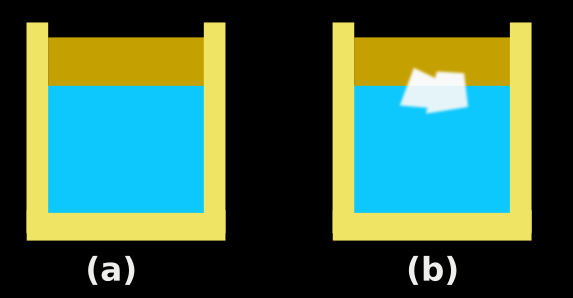
1. Consider the open vessel in fig.6.20(a) below. It contains some water at room temperature 25C

Second law of thermodynamics
Fig.6.20

2. We know that, a mass of water is nothing but a collection of H2O molecules
• All those molecules are in random motion
• So all those molecules have kinetic energies
• The temperature of the water mass is the average kinetic energy of the molecules
3. Due to the random motion, the molecules are constantly colliding with each other
• Imagine that, due to the collisions, some molecules near the surface of the water, looses considerable kinetic energies
    ♦ Then the temperature of those molecules will fall
• Let the temperature fall to such a low level that, those molecules freeze and become ice
4. Remember that, loss of kinetic energy is due to collisions. The kinetic energies lost by the molecules will be gained by the surrounding molecules
• So, when the molecules freeze and become ice, the surrounding molecules become warm
• We will get some ice at the center of the vessel and that ice will be surrounded by warm water. This is shown in fig.6.20(b)
5. Formation of ice in this manner, does not defy the law of conservation of energy because,
    ♦ there is no destruction of energy
    ♦ also, no energy is created
• The energy lost by some molecules is gained by some other molecules
6. Even though the law of conservation is obeyed, we never see such a spontaneous formation of ice at room temperature


• A Spontaneous process is the one which do not require external source of energy to proceed
• For a process to be called spontaneous, it is not necessary that it occurs at a high speed
• A slow process can also be called spontaneous if it does not require external supply of energy
• The reaction between hydrogen and oxygen is an example of a slow spontaneous process
    ♦ A mixture of H2 and O2 can be left undisturbed in a container for many years
    ♦ There will not be any noticeable effects
    ♦ But the reaction will be taking place all the time, with out any aid of external energy

7. The spontaneous formation of ice in this manner requires heat to flow (without external help) from a cold object to a hot object
◼ We never observe such a flow. What we observe is the flow of heat from hot object to cold object
• We can say:
    ♦ The spontaneous process proceeds only in one direction: Ice Water
    ♦ We never see the spontaneous process: Water Ice
        ✰ For this process, we have to supply energy through a refrigerator
◼ In fact, all naturally occurring processes (physical or chemical) will tend to proceed in one direction only
8. Let us see another example:
• If a canister containing some gas is opened, the gas molecules will spontaneously spread out into the whole volume of the room
• We never see the gas molecules in the room to enter back spontaneously into the canister
9. One more example:
• Consider the burning of carbon
• During the process, carbon combines with oxygen to give carbon dioxide
    ♦ That is: C + O2 → CO2
    ♦ This is a spontaneous process
    ♦ Once the carbon is ignited, no external energy is required to keep the process going
• In the reverse process, carbon and oxygen is obtained from carbon dioxide
    ♦ That is: CO2 → C + O2
    ♦ This reverse process is not spontaneous
    ♦ Energy is required to accomplish this reverse process
10. We see that, all spontaneous processes proceed in one direction only
• We want to answer this question:
Why all spontaneous processes proceed only in one direction?
11. To find the answer, we consider some common phenomena that we see in our day to day life
(i) Flowing of water
• The flow of water starts from top of hill and ends at the ground level
• During the flow, the potential energy stored in the water is continuously released in the form of kinetic energy
• When the water reaches the ground level, it’s potential energy will be zero. This is because, all the potential energy is released (in the form of kinetic energy) into the surroundings
(ii) Stone falling from a height
• The fall of stone starts from a higher level and ends at the ground level
• During the fall, the potential energy stored in the stone is continuously released in the form of kinetic energy
• When the stone reaches the ground level, it’s potential energy will be zero. This is because, all the potential energy is released (in the form of kinetic energy) into the surroundings
12. The flow of water and fall of stone are spontaneous processes. They do not require any aid of external energies
• So we are inclined to think that:
All processes in which there is a ‘release of stored energy’ will be spontaneous
13. We know that, in exothermic reactions, the stored chemical energy is released as heat energy
• So we are inclined to think that:
    ♦ All exothermic reactions are spontaneous
    ♦ The reverse of an exothermic reaction is endothermic
        ✰ It involves absorbtion of energy
    ♦ So a spontaneous reaction proceeds in the exothermic direction only
• Let us examine whether this is true
14. Some thermochemical equations are given below:
(i) 1/2N2(g) + 3/2H2(g) NH3(g); ΔHr = – 46.1 kJ mol-1
(ii) 1/2H2(g) + 1/2Cl2(g) HCl(g); ΔHr = – 92.32 kJ mol-1
(iii) H2 + 1/2O2(g) H2O(l); ΔHr = –285.8 kJ mol-1
• The above three reactions are spontaneous
• The negative sign of ΔHr shows that, they are exothermic reactions
◼ So we become even more inclined to think that:
    ♦ All exothermic reactions are spontaneous
    ♦ Being exothermic is the only criterion for spontaneity
15. But before making a decision, let us see two more thermochemical equations:
(i) 1/2N2(g) + O2(g) → NO2 (g); ΔHr = +33.2 kJ mol-1
(ii) C(graphite, s) + 2S(l) → CS2(l); ΔHr = +128.5 kJ mol-1
• The above two reactions are spontaneous
• The positive sign of ΔHr shows that, they are endothermic reactions


◼ So it is impossible to conclude that:
Being exothermic is the only criterion for a reaction to be spontaneous
• Scientists became convinced that, there are some other factors also playing major roles
• Researches in this direction lead to the discovery of entropy and the second law of thermodynamics
• We will see them in the next section


Previous

Contents

Next

Copyright©2021 Higher secondary chemistry.blogspot.com